
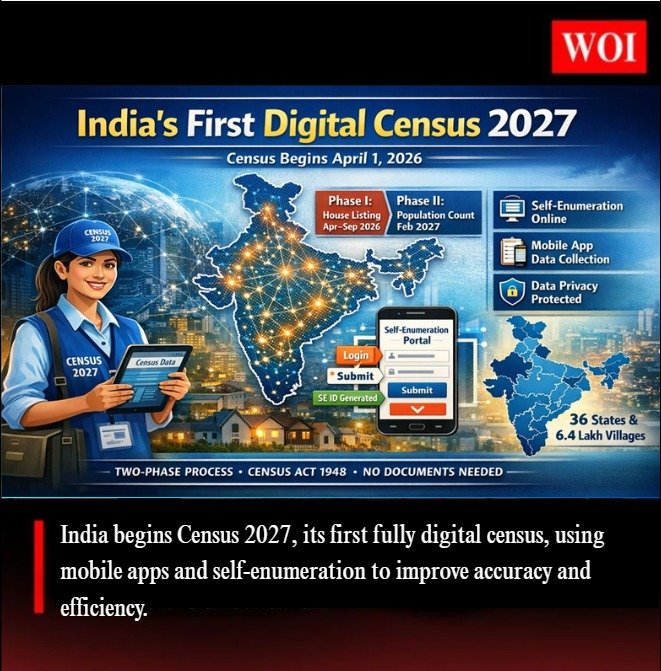
📊 India’s First Digital Census 2027 Begins: A Landmark Shift in Data Collection
India has officially launched Census 2027, marking a historic transition to the country’s first fully digital census. This nationwide exercise—the 16th Census of India and the eighth after Independence—introduces mobile applications and online self-enumeration, aiming to make data collection faster, more accurate, and transparent.
A Digital Leap in Census Operations
For the first time, census enumerators will use smartphone-based mobile apps instead of paper schedules, enabling real-time monitoring and quicker processing of data. Citizens also get a new option: self-enumeration, allowing them to fill in their details online without waiting for an enumerator—an unprecedented step in India’s census history.
Two-Phase Census Process
Census 2027 will be conducted in two structured phases:
- Phase I: Houselisting and Housing Census (April–September 2026)
Collects data on housing conditions, amenities, and household assets. A 15-day self-enumeration window will be available before field visits begin. - Phase II: Population Enumeration (February 2027)
Gathers individual-level details such as demographics, education, migration, and fertility.
The reference date is 1 March 2027 for most of the country, while snow-bound regions like Ladakh, Jammu & Kashmir, Himachal Pradesh, and Uttarakhand will follow 1 October 2026.
Scale, Cost, and Significance
With an approved budget of ₹11,718.24 crore, Census 2027 is among the world’s largest data collection exercises. The investment covers digital infrastructure, enumerator training, and system development.
Overall, Census 2027 represents a transformative moment for the Census of India, setting new benchmarks in governance, planning, and evidence-based policymaking for the digital era.
