
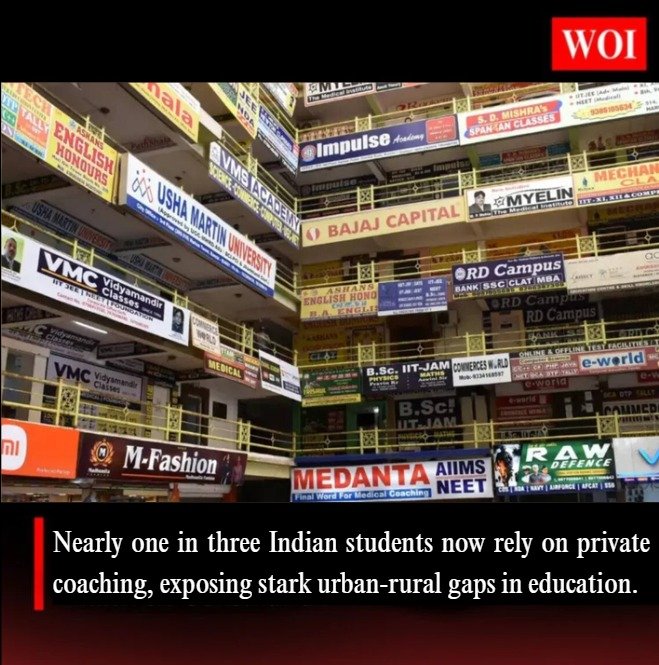
India’s education system is witnessing a sharp rise in shadow schooling — private tuition or coaching outside regular classes. According to the Comprehensive Modular Survey (CMS) by the Ministry of Statistics, nearly one in three students now attend private coaching, with the trend strongest in urban areas.
While 56% of children nationwide still study in government schools, cities show a tilt toward private education, with only 30% of urban students in government institutions. Costs reveal a stark contrast — government school spending averages ₹2,863 per student annually, while private school spending soars to ₹25,002.
Private coaching adds another layer of expense. Around 27% of students take tuition, with urban families spending nearly double what rural households do. At higher secondary levels, coaching costs in cities climb close to ₹10,000 annually.
The survey shows 95% of education costs are borne by families, with minimal government scholarships. This dual system highlights widening inequalities: rural areas rely on affordable government schools, while urban families increasingly turn to private schools and coaching.
As India moves forward with the National Education Policy (NEP), the challenge remains — how to bridge the urban-rural divide and make quality education truly accessible for all.
