
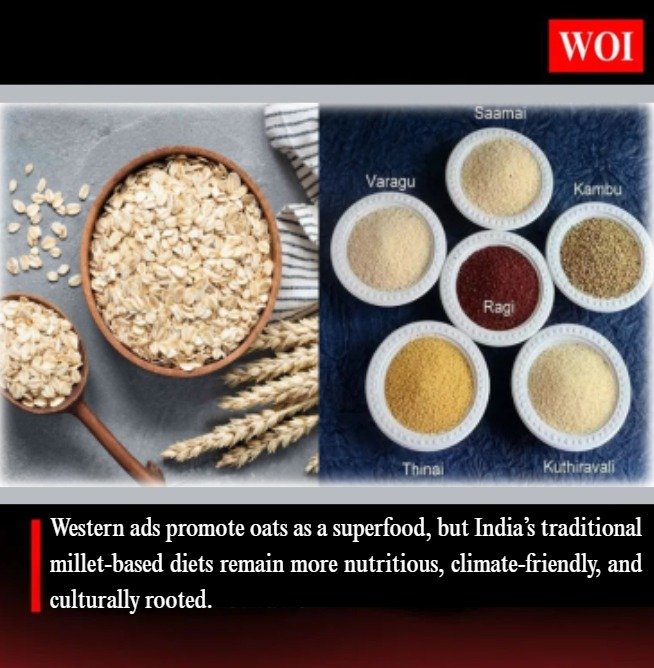
The Politics of Nutrition: How Ads Overshadow India’s Food Wisdom
By Rupasri Pattanayak
Whenever we Indians speak of nutritious food, it is our traditional food that first come to mind. Historically, these foods were understood not merely as sources of energy but as a means to sustain health, balance, and well-being. The idea of nutrition in India has always been shaped by cultural practices, the principles of Ayurveda, religious influences, and the interplay between geography and agriculture. What we consumed was closely tied to what the land provided, the seasons dictated, and the body’s inner balance required.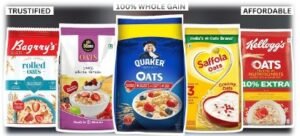 Traditional Indian diets are usually vegetarian in many regions, driven by religion. Millets were consumed as the primary source of carbohydrates, and lentils were considered the main source of protein. Foods are chosen to the swing of the season: cooling foods such as ice apple, buttermilk, and cucumber in the summer season and warming foods such as sesame, clarified butter, jaggery, and peanut in the winter. In India, locally grown fresh food is valued more than processed food.
Our spices are more medicines, such as pepper, cardamom, turmeric powder, ginger, black cumin, cumin, long pepper, and carom seed, which are consumed to boost immunity, help in digestion, and prevent diseases. Culturally, we consume milk, curd, and clarified butter, which are considered complete foods and boost strength as well as immunity. Freshly prepared home-cooked meals are considered superior to preserved or packaged or canned or outside food.
With all these nutrient-rich foods around us, the commercials nowadays popping up on our screens are to eat oats, as they’re healthy, full of fibre, good for digestive health, and what not. They display them on the silver screen in the name of selling the Western cereal in my country as if my country lacks superfoods. Oats are not a grain that is historically or traditionally grown or consumed in India. For those who have weak digestion, oats can cause bloating and gas, as they’re heavy and slightly cooling in nature.
 The slimy and sticky nature of oats can increase kapha if eaten excessively. Though nutrition-wise, oats are rich in beta-glucan, which is good for the heart and cholesterol. But Indian millets, such as pearl millets, finger millets, and barnyard millets, just to name a few, have more micronutrients, are naturally adapted to our climate and bodies, and offer better benefits.
If oats are cooked well with digestive spices such as cumin, black pepper, ginger, and cinnamon, then they can be alright for Indian-type bodies. The target buyers of oats in India are urban lifestyle folks who can’t always make fresh traditional breakfasts. For them, oats is a practical substitute. If prepared like the Indian way of preparing upma with veggies and spices, the western style of porridge with milk and sugar can cause sluggish digestion, diabetes, and obesity. Though oats are not the wrong food, they are not a natural part of Indian food wisdom.
Global food companies, such as Kellogg, Nestlé, and PepsiCo, and national food companies like Patanjali and Saffola spend crores on advertising to brainwash Indian minds, creating the idea that Western foods are superior. This is called nutrition versus the political economy of food. The taglines of western nutrition science, such as “cholesterol,” “fibre,” and “glycemic index,” are catchy terms that glue educated middle-class Indian minds. These catchy terms give the impression that traditional foods are outdated and western grains are more scientific.
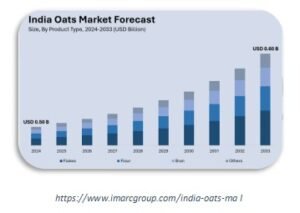
It’s in the past century; to siphon off to their county, the Britishers encouraged cash crops instead of millets. We witnessed a decline in the production and consumption of millets. Millets were seen as poor men’s food, which actually needs less attention, less water, and less expense to produce in comparison to the cash crops. Later the green revolution focuses mainly on the production of wheat, rice, cotton, and sugarcane instead of bajra, jowar, foxtail millet, and kodo millet, all rich in fibre and minerals and ideal for Indian digestion.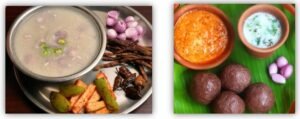 Oats in India are largely imported from Australia and Ukraine, which makes India dependent on foreign agriculture. The MNCs sell oats at premium prices, earning huge profit margins.
 In Samuel Johnson’s A Dictionary of the English Language (1755), his definition of “Oats” became legendary for its humour and national bias: “Oats: A grain, which in England is generally given to horses, but in Scotland supports the people.” Though the definition was derogatory in nature, it showed the view of the people of England on oats in those bygone days. Health is not always about just fibre or cholesterol. It means digestion, mental calmness, immunity, and much more. A bowl of ragi mudde, bajra roti, or khichdi with clarified butter can do more wonders for the human body than a packet of instant oats.
