
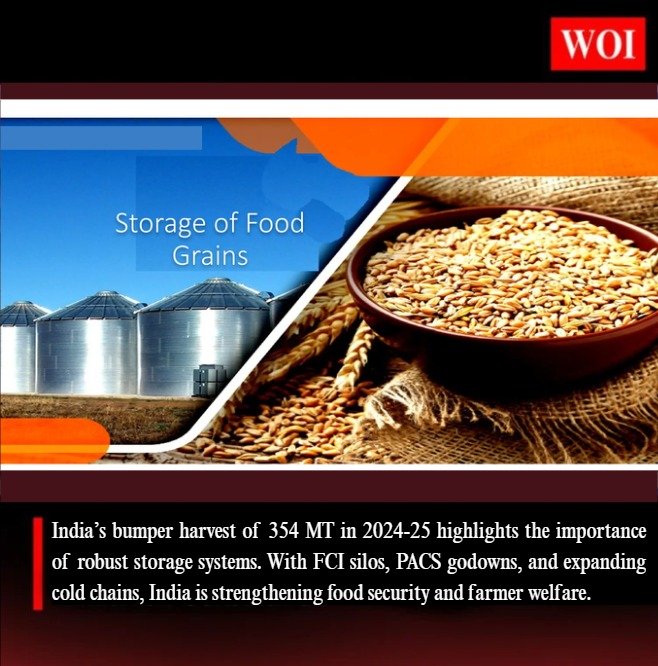
India recorded a bumper foodgrain production of nearly 354 million tonnes in 2024-25, including 117 million tonnes of wheat and 149 million tonnes of rice, reinforcing its global leadership in agriculture. This achievement has underscored the critical role of storage infrastructure in safeguarding national food security.
Significance of Storage:
Efficient storage minimises post-harvest losses, preserves quality, and stabilises prices. It also empowers farmers by preventing distress sales and enabling better income through scientific preservation methods.
Centralised & Decentralised Storage:
The Food Corporation of India (FCI) plays a vital role with over 917 LMT storage capacity, forming the backbone of the Public Distribution System. At the grassroots, Primary Agricultural Credit Societies (PACS) operate decentralised godowns, cutting costs and boosting efficiency, with 73,000 PACS computerised for transparency.
Cold Storage & Modernisation:
India operates 8,815 cold storages with a capacity of 402 LMT, crucial for perishables. Government schemes like PMKSY, AIF, and AMI are expanding warehouses, silos, and cold chains. By mid-2025, 27 LMT capacity silos are operational with more underway.
World’s Largest Grain Storage Plan:
Launched in 2023, this cooperative-based plan transforms PACS into multi-service centres, with pilot projects already active in 11 states. Over 500 PACS godowns are being expanded to strengthen rural storage and agri-infrastructure.
Conclusion:
With modern silos, expanded cold chains, and cooperative-led storage, India is not only securing its foodgrain surplus but also building a resilient system to support farmers and ensure long-term food security.
