
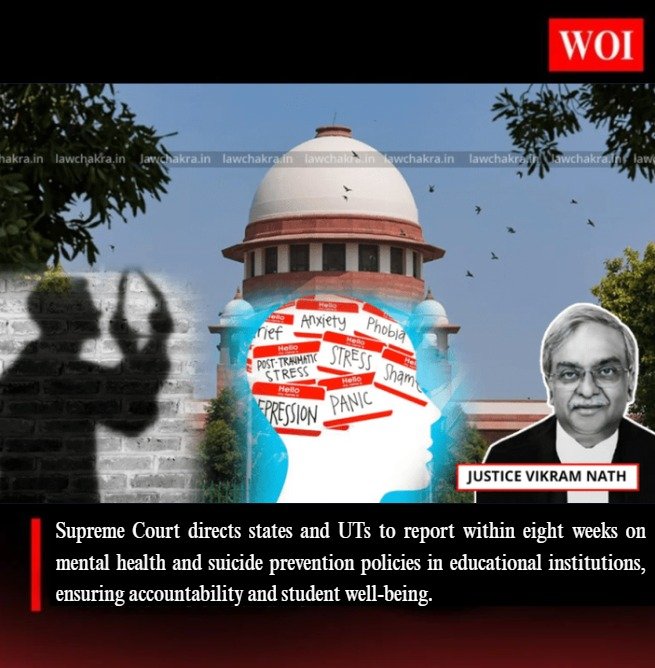
In a significant move to tackle the rising incidence of student suicides, the Supreme Court of India has directed all states and Union Territories to submit compliance reports within eight weeks on the implementation of its mental health and suicide prevention guidelines for educational institutions.
Court’s Directive
A bench of Justices Vikram Nath and Sandeep Mehta instructed both the Centre and state governments to file affidavits detailing measures taken to safeguard student mental health. All states and UTs have been made respondents in the case, with the next hearing scheduled for January 2026.
Uniform Mental Health Policy
The Court reaffirmed its July 25 ruling, which mandated a uniform mental health policy across all schools and colleges. This framework must draw from the ‘Ummeed’ draft guidelines, ‘Manodarpan’ initiative, and the National Suicide Prevention Strategy. Institutions are required to review policies annually and display them publicly on websites and notice boards.
Bridging Policy Gaps
The bench highlighted the absence of a legal framework for suicide prevention in student environments. Until such a law is enacted, the Court’s 15 interim guidelines remain binding. These include mandatory registration and student protection rules for private coaching centres, which have faced criticism following multiple student suicides.
Government Initiatives
The Ministry of Education’s ‘Ummeed’ (Understand, Motivate, Manage, Empathise, Empower, Develop) and ‘Manodarpan’ programmes are central to this initiative, promoting emotional resilience and mental well-being among students.
Exam-Oriented Facts
- All states/UTs must report on suicide prevention within 8 weeks.
- Uniform mental health policy to be based on Ummeed, Manodarpan, and National Suicide Prevention Strategy.
- ‘Ummeed’ launched in 2023 by the Ministry of Education.
- The case was triggered by the suicide of a 17-year-old NEET aspirant in Andhra Pradesh.
Towards a Supportive Learning Environment
The Court’s directive marks a crucial step toward building emotionally secure and empathetic educational spaces. By enforcing compliance and accountability, it aims to ensure that no student feels isolated or unsupported in India’s education system.
