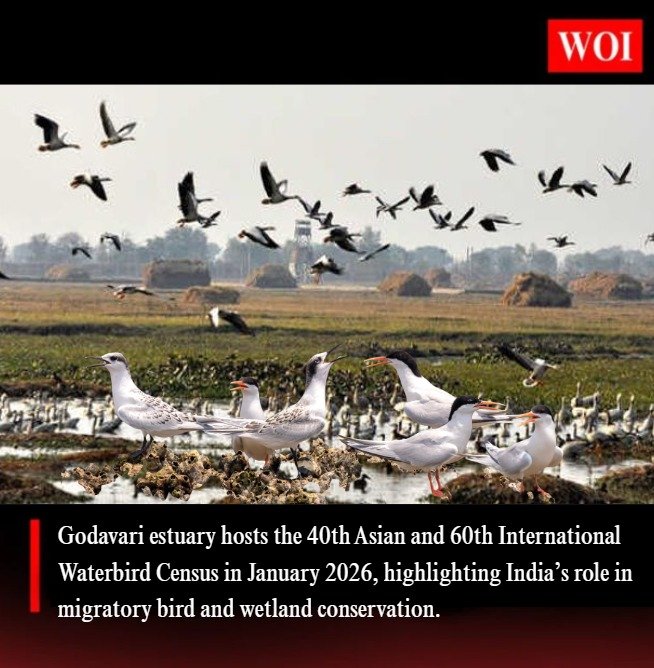
The 40th Asian Waterbird Census (AWC) along with the 60th International Waterbird Census (IWC) will be conducted on 10–11 January 2026 at the Godavari estuary, including the ecologically significant Coringa Wildlife Sanctuary in Andhra Pradesh. The event highlights India’s growing role in global wetland conservation and long-term monitoring of migratory waterbirds.
The census will be jointly organised by the Andhra Pradesh Forest Department, Bombay Natural History Society (BNHS), Wildlife Institute of India (WII), and World Wide Fund for Nature (WWF), with active participation from local birdwatchers and volunteers. This collaboration ensures scientific rigour and international comparability of data.
The Godavari estuary is one of the rare sites in India where two globally Endangered species—the Indian Skimmer and the Great Knot—occur together, making it a priority landscape for avian conservation. Other key species to be monitored include the Eurasian Curlew (Near Threatened) and the Eurasian Oystercatcher, both important indicators of coastal wetland health.
The Coringa mangroves, India’s second-largest mangrove ecosystem, provide critical feeding and roosting habitats for migratory birds. Data from the census will help assess wetland health, track population trends, identify conservation priorities, and support India’s commitments under international frameworks such as the Ramsar Convention and the Convention on Migratory Species.
The 2026 census marks six decades of continuous global waterbird monitoring and underscores the ecological importance of the Godavari estuary in sustaining migratory bird populations.
