
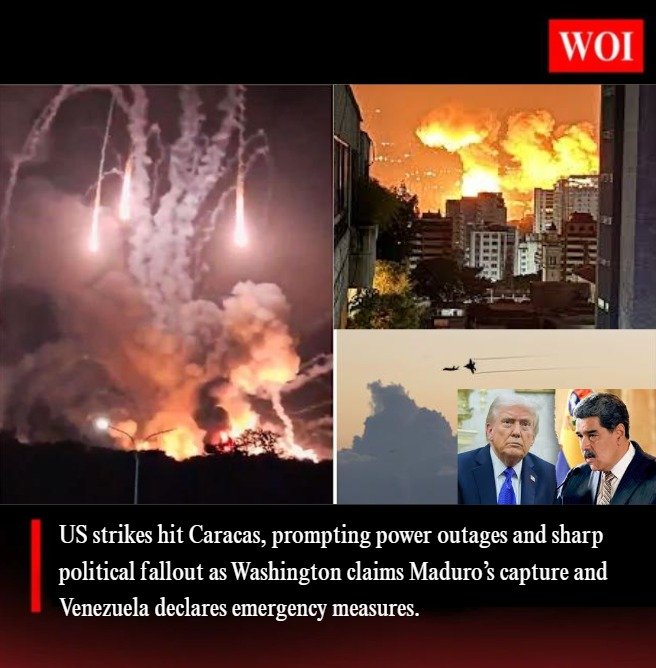
The United States launched a large-scale military strike on Venezuela in the early hours of January 3, triggering explosions across the capital Caracas and causing power outages in several areas. The operation, which reportedly lasted under half an hour, targeted key locations near military installations, with residents describing loud blasts, shaking buildings and low-flying aircraft over the city.
US President Donald Trump claimed that Venezuelan President Nicolás Maduro and his wife had been captured and flown out of the country, a statement that has added to uncertainty over Venezuela’s political situation. The announcement was made via social media, with further details promised at a news conference. Following the strike, US aviation authorities imposed an immediate ban on flights over Venezuelan airspace.
The Venezuelan government strongly condemned the action, calling it an attack on national sovereignty and accusing the US of striking civilian and military infrastructure. Authorities declared a state of external disturbance, activated national defence plans and urged citizens to mobilise.
The incident has heightened regional and global tensions, drawing criticism from several countries and raising concerns within the US over congressional approval for the operation. The situation remains fluid, with significant implications for Venezuela’s stability and broader geopolitics.
