
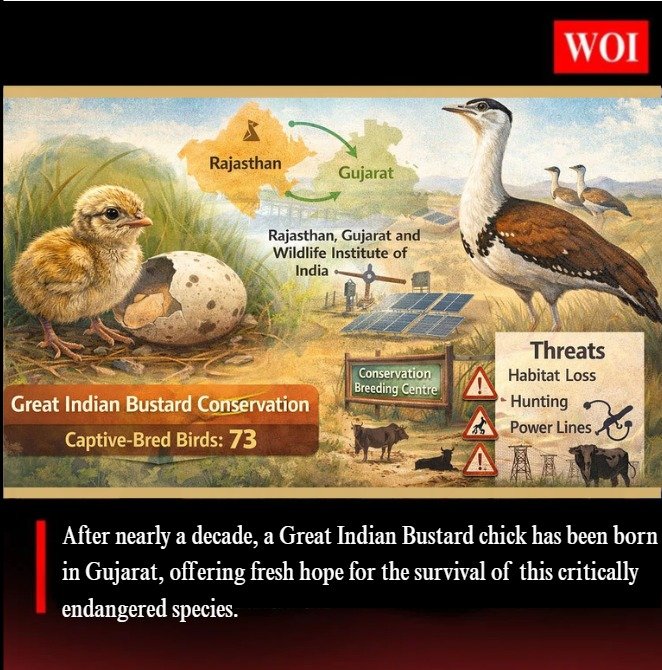
In a significant boost to India’s wildlife conservation efforts, a Great Indian Bustard (GIB) chick has been born in the grasslands of Kutch, Gujarat, after nearly a decade. This rare event marks the first successful breeding of the critically endangered bird in the state since 2016 and has renewed hopes for the species’ survival.
The Great Indian Bustard, one of the heaviest flying birds in the world, is listed as Critically Endangered by the International Union for Conservation of Nature (IUCN), with fewer than 150 individuals left in India. In Gujarat, the situation had become especially alarming, with only a few surviving females and no breeding success for years.
A Breakthrough “Jumpstart Approach”
The chick’s birth was made possible through an innovative “Jumpstart Approach”, under which a fertile, partially incubated egg was transported from Rajasthan to Gujarat and placed in a wild nest for natural incubation. The egg was carefully moved over a distance of about 770 km using a portable incubator.
The effort was jointly coordinated by the Ministry of Environment, Forest and Climate Change, the Wildlife Institute of India, and the forest departments of Rajasthan and Gujarat.
Why It Matters
This successful hatching revives breeding potential in Gujarat, demonstrates effective inter-state cooperation, and offers a promising model for future conservation interventions. However, challenges such as habitat degradation, power line collisions, and the extremely small population continue to threaten the long-term survival of the Great Indian Bustard.
Even so, the birth of this chick stands as a rare and hopeful milestone in India’s fight to save one of its most iconic grassland species.
