
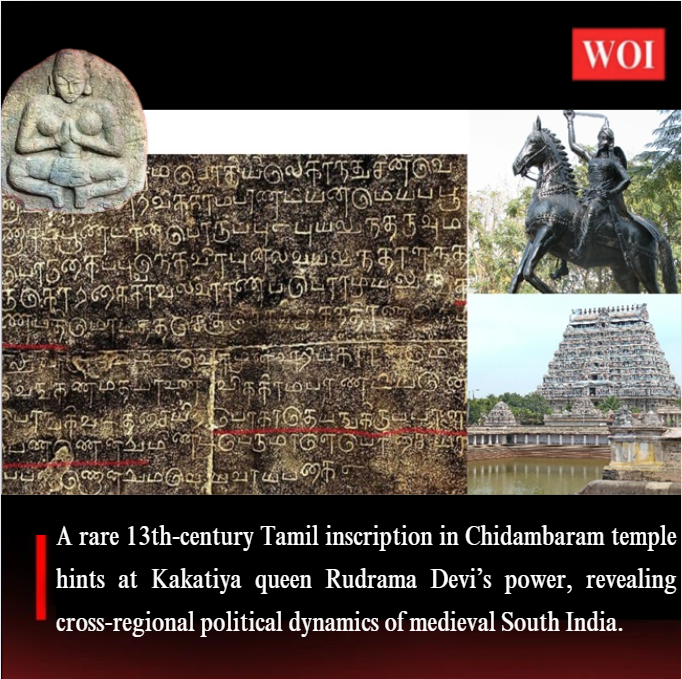
In a remarkable archaeological discovery, a Tamil inscription has been found at the Nataraja temple in Chidambaram, Tamil Nadu, offering an unusual and valuable reference to the legendary Kakatiya ruler, Rudrama Devi. This 13th-century epigraph sheds new light on the complex political and cultural interactions between different regions of South India during the medieval period.
Key Highlights of the Discovery:
- Location and Language:
The inscription is engraved in classical Tamil (Centamil) on the western gopuram (left of the entrance) of the famed Nataraja temple, one of the most iconic religious sites in Tamil Nadu. - Dating:
Based on epigraphic analysis, the inscription dates back to the 13th century, placing it in the era of flourishing South Indian kingdoms such as the Pandyas and the Kakatiyas. - Reference to Rudrama Devi:
Though her name is not explicitly mentioned, the inscription alludes to a powerful female ruler in the north, a likely reference to Rani Rudrama Devi, the courageous and trailblazing monarch of the Kakatiya dynasty in present-day Telangana. This mention is especially significant given the rarity of such cross-regional references to women rulers in ancient Tamil inscriptions. - Victory of Vikrama Pandya:
The inscription also highlights the military success of Pandya King Vikrama Pandya, particularly his triumph over the Venadan (Travancore) ruler at Podiyil. The text praises the king with honorific titles such as Bhuvanekavira and Korkai-kavalan, suggesting his prowess and influence.
Historical Significance:
Perhaps the most fascinating part of the inscription is found in its second and third verses, which indicate that King Vikrama Pandya chose not to advance further into the northern territories. This restraint might hint at the presence of a formidable political or military power in the north—strengthening the interpretation that it refers to Queen Rudrama Devi’s reign.
This discovery offers a rare and valuable glimpse into the inter-regional political diplomacy, power dynamics, and the recognition of women rulers in medieval South India. It also underscores the cultural and political interconnectedness between the Tamil and Telugu regions during that era.
