
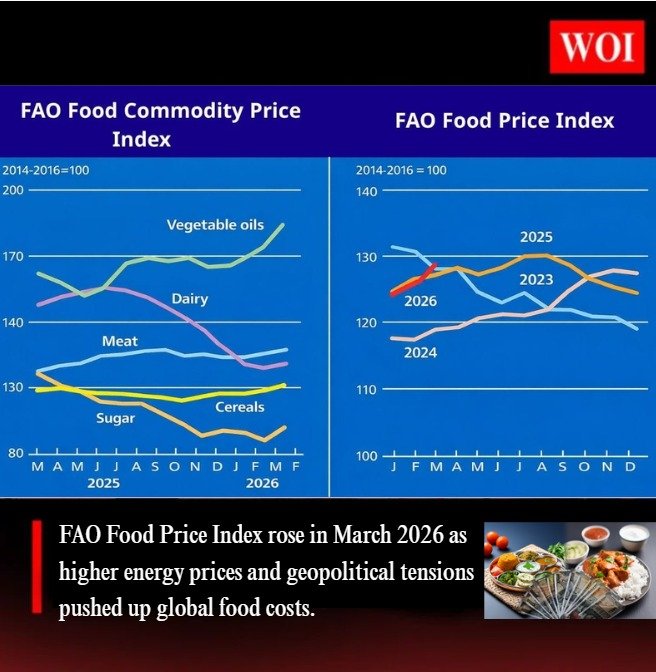
The FAO Food Price Index recorded an increase in March 2026, signalling renewed pressure on global food markets amid rising energy costs and escalating geopolitical tensions in the Middle East. The surge underscores how closely global food prices are linked to external shocks such as conflicts, fuel price volatility, and disruptions in supply chains.
The FAO Food Price Index is a widely tracked global indicator that measures monthly changes in international prices of major food commodities. It is calculated as a weighted average of five key commodity groups—cereals, vegetable oils, dairy products, meat, and sugar—using average export shares to reflect their importance in global trade. The base period for the index is 2014–16, allowing consistent comparison over time.
The rise in March was largely driven by higher energy costs, which increase production and transportation expenses across agricultural supply chains. Such cost pressures often translate into higher food prices, especially for energy-intensive commodities, highlighting the vulnerability of food systems to geopolitical instability.
The index is published by the Food and Agriculture Organization (FAO), a specialised agency of the United Nations working to eliminate hunger and improve global food security. Headquartered in Rome, FAO supports member countries through research, policy guidance, and flagship reports such as The State of Food Security and Nutrition in the World (SOFI) and The State of Agricultural Commodity Markets (SOCO).
Overall, the March 2026 increase in the FAO Food Price Index reinforces the importance of resilient food systems and coordinated global action to mitigate the impact of geopolitical and energy-related shocks on food affordability and security.
