
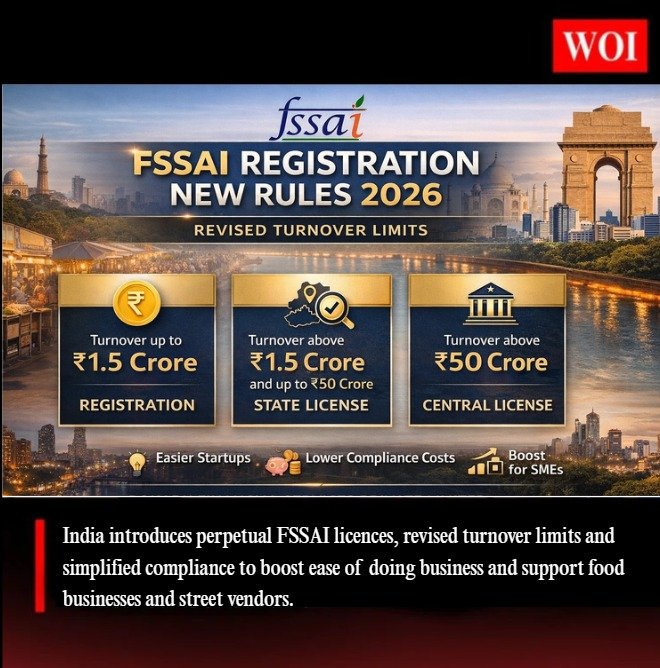
India has introduced major reforms in the food safety regulatory system to improve the ease of doing business. The Ministry of Health and Family Welfare has approved perpetual validity for licences and registrations issued by the Food Safety and Standards Authority of India (FSSAI), eliminating the need for repeated renewals by food businesses.
Under the new system, once a food business operator obtains an FSSAI licence or registration, it will remain valid indefinitely unless suspended or cancelled due to violations. This reform is expected to reduce paperwork, lower compliance costs, and allow authorities to focus more on monitoring food safety rather than handling routine licence renewals.
The government has also revised turnover limits for licensing, effective from April 1, 2026. The threshold for basic registration has been increased from ₹12 lakh to ₹1.5 crore, while businesses with turnover up to ₹50 crore will require a state licence and those above ₹50 crore will need a central licence.
Additionally, street food vendors already registered with municipal bodies under the Street Vendors Act, 2014 will now be automatically recognised under FSSAI, benefiting more than 10 lakh vendors by removing the need for multiple registrations.
The government is also introducing a risk-based inspection system using technology to ensure that high-risk businesses are monitored more closely while compliant businesses face fewer inspections. These reforms aim to simplify regulations, support small businesses, and strengthen food safety standards across India.
