
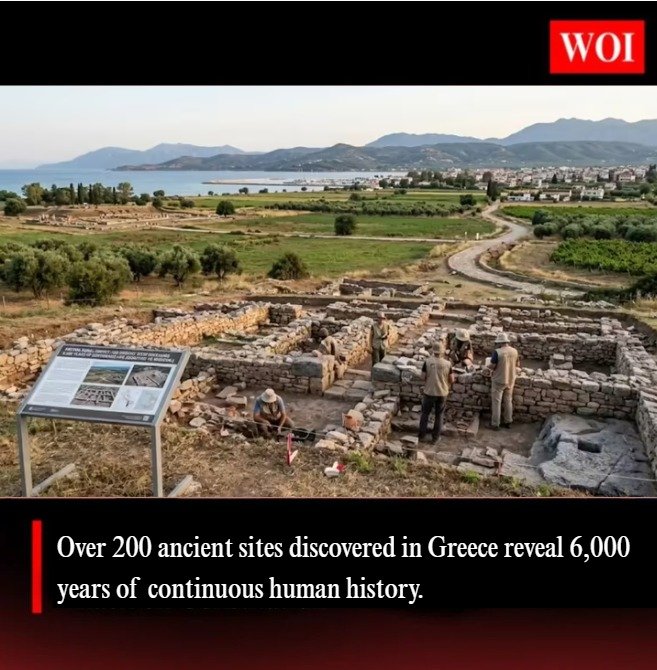
A major archaeological survey in Greece has revealed over 200 ancient sites, shedding light on nearly 6,000 years of continuous human settlement. Conducted in the Eretrian plain region of Evia, the findings highlight the evolution of rural life and economic systems from prehistoric times to the modern era.
The survey, led by the Swiss School of Archaeology in Greece, covered more than 30 square kilometres and identified a variety of sites, including farms, settlements, quarries, and medieval road networks. These discoveries illustrate how rural landscapes supported the urban centre of Eretria and nearby religious hubs like the Sanctuary of Artemis at Amarynthos.
A key breakthrough came through the use of advanced LiDAR technology, which enabled researchers to detect hidden structures beneath dense vegetation. This method revealed buried walls, terraces, and ancient routes that were previously invisible, providing a more detailed understanding of the region’s historical layout.
The study also highlights how ancient communities were organised into “demes,” functioning as local socio-economic centres. Evidence such as olive presses and road networks points to a thriving agricultural economy that ensured connectivity and sustainability over centuries.
Overall, the findings confirm that the Eretrian plains experienced continuous human habitation across multiple historical periods, offering valuable insights into long-term settlement patterns and the resilience of ancient societies.
