
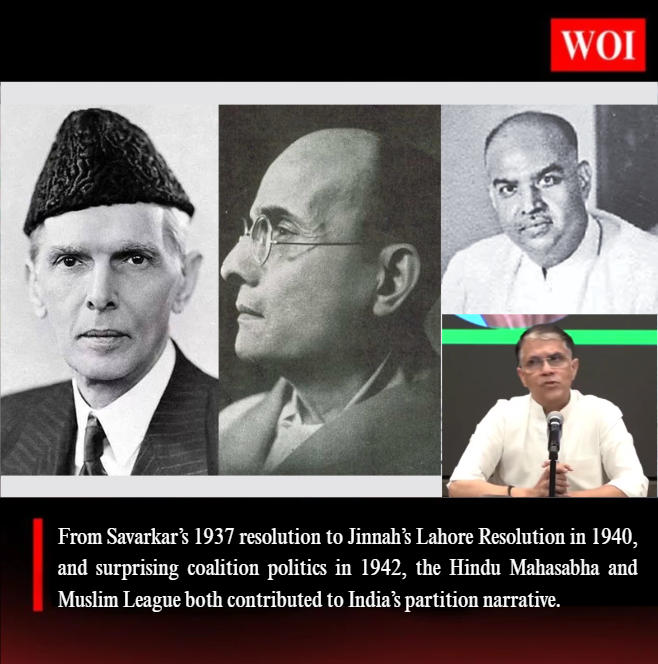
The partition of India in 1947 is often traced back to the rising communal divide between the Hindu Mahasabha and the Muslim League. However, the years between 1937 and 1942 were especially crucial, as both organizations—despite their ideological opposition—played roles that indirectly reinforced the two-nation theory.
1937: Hindu Mahasabha’s Ahmedabad Session and Savarkar’s Two-Nation Resolution
In 1937, the Hindu Mahasabha, under the leadership of Vinayak Damodar Savarkar, held its session in Ahmedabad. It was here that Savarkar presented the idea of Hindus and Muslims as two distinct nations, bound by separate cultural, religious, and historical identities.
- He argued that India was not a homogeneous nation but a land of two nations.
- This early articulation of the two-nation idea by a Hindu leader was significant, as it mirrored what the Muslim League would formally declare three years later.
1940: Muslim League’s Lahore Resolution
In March 1940, the Muslim League, led by Muhammad Ali Jinnah, held its historic session in Lahore.
- The Lahore Resolution, often called the “Pakistan Resolution,” explicitly called for the creation of independent states for Muslims in the north-western and eastern parts of India.
- This was a formal political endorsement of the two-nation theory, which became the ideological foundation for Pakistan.
While Savarkar had earlier spoken of Hindus and Muslims as separate nations, Jinnah’s resolution transformed the idea into a concrete political demand.
1942: The Paradox of Alliances – Hindu Mahasabha and Muslim League in Government
Despite being ideologically opposed, both the Hindu Mahasabha and the Muslim League engaged in political collaboration during 1942.
- In Bengal, NWFP (North-West Frontier Province), and Sind, the two parties came together to form coalition governments.
- In the Sind Assembly, M. Syed, a prominent Muslim leader, moved a resolution in favor of Pakistan. Notably, even as the resolution gained ground, the Hindu Mahasabha chose to remain part of the government, highlighting a paradox in Indian politics of the time.
Significance and Contradictions
- Ideological Roots of Partition: Both Savarkar’s Hindu Mahasabha and Jinnah’s Muslim League contributed, in different ways, to legitimizing the idea of two nations.
- Political Pragmatism vs. Ideology: Despite strong rhetoric, practical politics led the Hindu Mahasabha to share power with the Muslim League, even when the latter was openly pushing for Pakistan.
- Reinforcing Divides: These parallel actions—Savarkar’s 1937 declaration and Jinnah’s 1940 resolution—deepened communal divides, eventually paving the way for partition.
Between 1937 and 1942, India witnessed a convergence of ideological assertions and political pragmatism that accelerated the journey toward partition. While Savarkar laid down the idea of two nations from the Hindu Mahasabha’s platform, Jinnah and the Muslim League transformed it into a mass political demand. The collaboration between the two parties in provincial governments, despite their rivalry, reflects the complexities of pre-independence politics—where pragmatism often overshadowed principle.
The period thus remains critical in understanding how both organizations, though adversaries, inadvertently worked along parallel paths that ultimately shaped the history of the subcontinent.
