
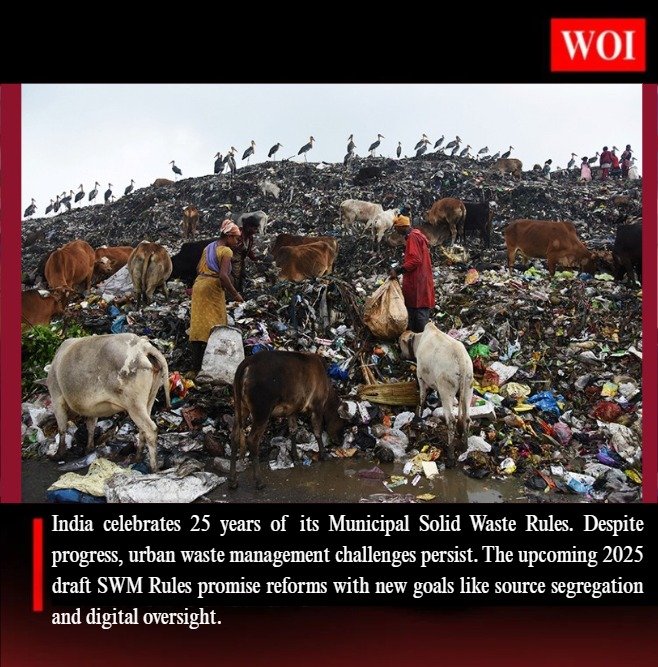
India marks 25 years since its first Municipal Solid Waste (MSW) Management Rules were introduced in 2000. Despite evolving regulations and increased infrastructure, many cities continue to face serious waste management challenges. The upcoming 2025 draft Solid Waste Management (SWM) Rules aim to tackle these issues with new measures like four-way source segregation and digital monitoring. However, systemic weaknesses and implementation gaps remain significant obstacles.
The MSW framework has expanded over two decades, adding rules for plastic, e-waste, biomedical, and hazardous waste, all designed to create cleaner urban spaces. Yet cities like Delhi, Bengaluru, and Gurugram still battle overflowing landfills and ineffective treatment plants. Key problems include weak local governance, poor contract oversight, and low public trust, which hamper progress.
While the 2016 Rules mandated 100% source segregation within two years, this target has largely remained unmet. In practice, timely waste collection and strict anti-littering enforcement are more impactful than ambitious segregation goals. Additionally, inconsistent and scarce waste data undermines effective planning and leads to mixed waste streams that overload treatment facilities.
A phased, localized approach is essential for India’s diverse urban environments. Priorities should include better waste characterization, robust collection systems, and managing homogeneous waste streams separately. Strong governance and committed leadership are critical to translating regulations into real improvements.
The draft 2025 SWM Rules offer promising innovations, including digital platforms and circular economy integration, but their success will depend on practical, ground-level implementation tailored to local needs. Without this, India’s waste management challenges will continue despite evolving policy frameworks.
