
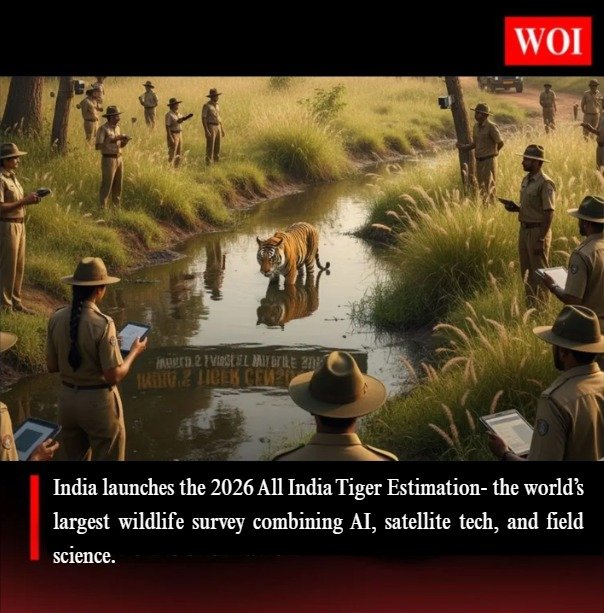
India is set to launch the 2026 All India Tiger Estimation (AITE), the world’s most extensive and advanced wildlife survey. Home to over 75% of the global tiger population, India uses this census not only to count tigers but also to assess the overall health of ecosystems — tracking prey density, forest quality, and human-wildlife interactions.
The previous 2022 survey recorded 3,682 tigers, reaffirming India’s leadership in conservation. The 2026 edition aims to combine traditional fieldwork with cutting-edge technology, including AI-based image recognition and satellite mapping, to ensure greater accuracy and ecological insights.
Three Phases of the 2026 Tiger Census
- Ground Surveys & Habitat Mapping:
Forest guards will walk 15 km transects across reserves, recording pugmarks, prey sightings, and vegetation health to evaluate habitat conditions. - Satellite Integration:
The Wildlife Institute of India (WII) will use satellite imagery and remote sensing to study forest cover, terrain, and human impact zones, helping pinpoint critical tiger corridors. - AI-Powered Camera Traps:
Over 40,000 motion-sensitive cameras will be deployed in a grid system. AI software will analyse stripe patterns to identify individual tigers — a method that identified 563 tigers in Karnataka alone in 2022.
Key Facts
- Survey Name: All India Tiger Estimation (AITE)
- Next Census: 2026
- Previous Count: 3,682 tigers (2022)
- Coverage: 400,000 sq km across 20+ states
- Personnel: Over 60,000 forest staff
The AITE 2026 will once again showcase India’s commitment to conservation excellence — blending science, technology, and field expertise to protect one of the world’s most iconic species.
