
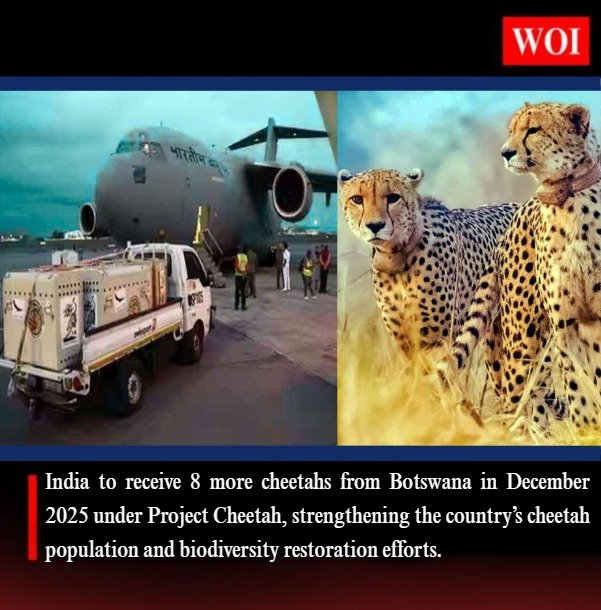
India is set to welcome eight new cheetahs from Botswana by December 2025, marking another milestone in Project Cheetah — the world’s first intercontinental large carnivore reintroduction initiative. The cheetahs, currently in quarantine in Botswana, will be relocated to Kuno National Park in Madhya Pradesh, where they will undergo further observation before release.
Project Cheetah: Reviving an Extinct Legacy
Launched to restore the cheetah to its historical range, Project Cheetah represents a global collaboration between India and African nations like Namibia, South Africa, and Botswana.
So far,
- India has introduced cheetahs from Namibia (2022) and South Africa (2023).
- The total population now stands at 27 cheetahs, including 16 born in India.
- Reintroductions have taken place at Kuno National Park and Gandhi Sagar Wildlife Sanctuary.
The upcoming Botswana batch will help increase genetic diversity and strengthen the population base for long-term survival in Indian ecosystems.
Challenges and Conservation Concerns
Despite successes, Project Cheetah faces challenges:
- Mortality Issues: Several adult and cub deaths have sparked questions about habitat suitability.
- Climate Mismatch: Experts note differences between African and Indian climates may affect adaptation.
- Conservation Debate: Critics argue for more focus on local ecosystem compatibility.
Still, the government remains optimistic, pointing to healthy local births and expanding habitat zones as signs of progress.
Quick Facts
- Cheetahs went extinct in India in 1952.
- First reintroduction: September 2022.
- Current population: 27 cheetahs (16 Indian-born).
- Next arrivals: 8 from Botswana, by December 2025.
- Key habitats: Kuno National Park, Gandhi Sagar, and Mukundra Hills.
Project Cheetah continues to symbolize India’s ambition to restore ecological balance and revive its wildlife heritage on a global conservation stage.
