
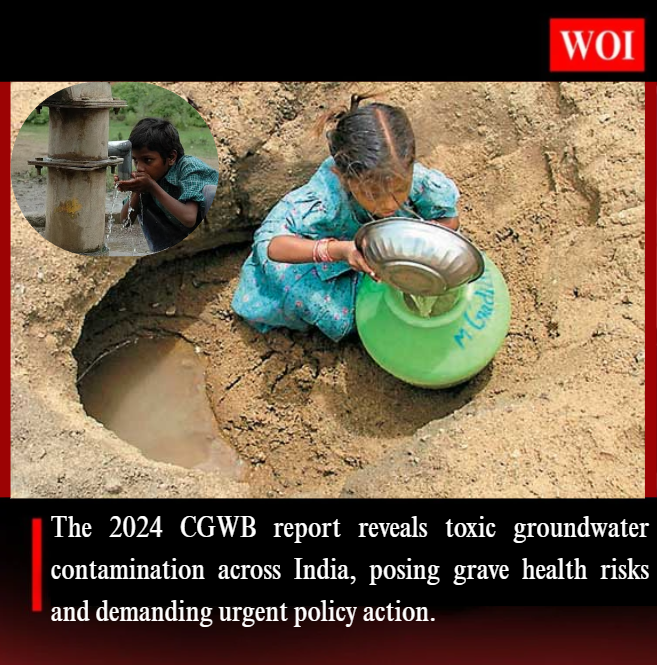
India’s groundwater, the backbone of rural drinking water and irrigation, faces a severe pollution crisis. The 2024 Central Ground Water Board (CGWB) report warns of widespread contamination by nitrates, fluoride, arsenic, uranium, and heavy metals — posing grave health risks, especially in rural communities.
Over 85% of rural drinking water and 65% of irrigation water comes from groundwater, making its quality vital for health and food security. Excess fertiliser use, poor sanitation, industrial waste, and over-extraction have worsened contamination.
Key Contaminants & Health Risks:
- Nitrates: Cause blue baby syndrome and hospitalisations.
- Fluoride: Leads to dental and skeletal deformities.
- Arsenic: Causes cancer and skin lesions, especially in Punjab and Bihar.
- Uranium & Heavy Metals: Damage kidneys, cause anaemia, and affect neurological health.
Case Studies:
- Budhpur, UP: Industrial waste linked to kidney failure deaths.
- Ballia, UP: Arsenic levels 20× above safe limits tied to thousands of cancer cases.
- Jalaun & Bhubaneswar: Petroleum-like water and sewage seepage caused mass illness.
Challenges & Reforms Needed:
India’s groundwater laws are weak, agencies underpowered, and monitoring sporadic. Experts call for a National Groundwater Pollution Control Framework, stronger enforcement, real-time monitoring, public access to data, strict industrial waste norms, regulated agrochemical use, and community-led water management.
Protecting groundwater is no longer optional — it’s essential for India’s future health, agriculture, and survival.
