
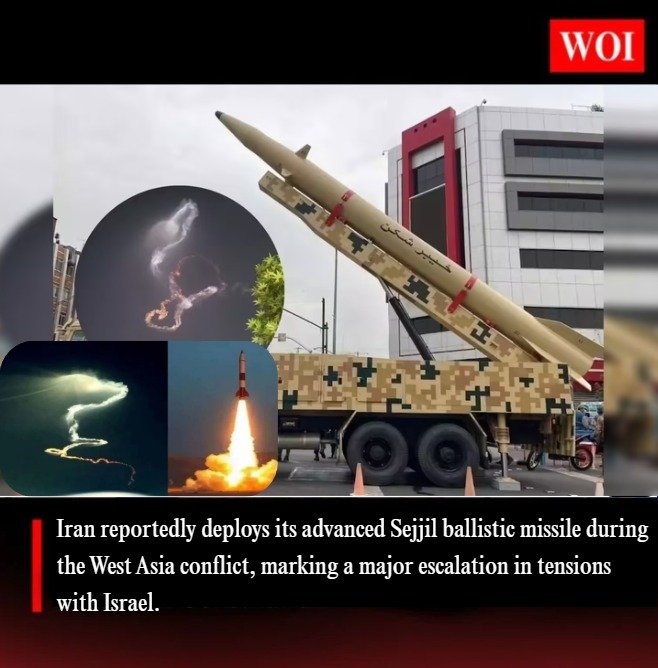
Iran has reportedly deployed its advanced Sejjil ballistic missile for the first time during the ongoing conflict involving Iran and Israel. The missile launch was part of Iran’s Operation True Promise 4, targeting Israeli military and administrative infrastructure. The move signals a significant escalation in tensions across West Asia, as the Sejjil is considered one of Iran’s most advanced long-range ballistic missiles.
The Sejjil missile is a two-stage, solid-fuel, surface-to-surface ballistic missile developed by Iran’s Aerospace Industries Organisation, which operates under the country’s defence ministry. Solid-fuel propulsion enables faster launch readiness compared to older liquid-fuel missiles such as the Shahab missile series that Iran had used since the late 1980s.
With an estimated range of around 2,000 kilometres, the missile can strike targets across much of the Middle East. It measures roughly 18 metres in length and can carry a warhead of about 700 kilograms. Military analysts note that the missile’s manoeuvrability during flight has earned it the nickname “Dancing Missile,” as it can alter its trajectory to make interception by air-defence systems more difficult.
Iran first successfully tested the Sejjil missile in 2008, later introducing an improved Sejjil‑2 missile variant. Reports have also suggested the potential development of a Sejjil-3 version with an extended range of up to 4,000 kilometres, although details about the exact variant used in the recent attack remain unclear.
