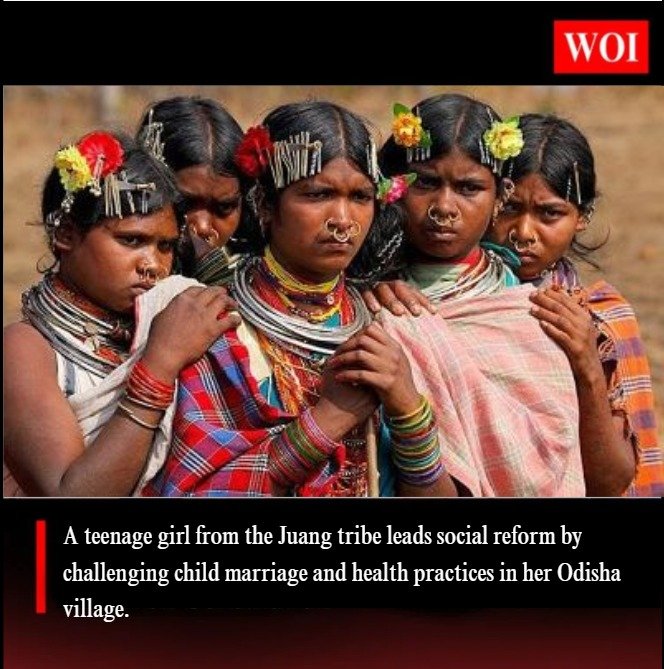
A 16-year-old girl from the Juang tribe in Odisha has emerged as a powerful agent of social change by persuading her village to rethink harmful practices related to child health and child marriage. Her initiative reflects a growing awareness within tribal communities and highlights how youth leadership can drive progressive reform, even among Particularly Vulnerable Tribal Groups (PVTGs).
The Juang tribe is one of the 13 PVTGs in Odisha and is mainly concentrated in the districts of Keonjhar and Dhenkanal. Due to their distinct socio-economic conditions and relative isolation, they receive special focus under tribal development programmes. Traditionally, the Juangs depended on hunting, gathering, and shifting cultivation. Over time, especially during the colonial period when forests were declared reserved, they adapted by taking up basket-weaving and barter trade to sustain their livelihoods.
Culturally, the Juangs speak the Juang language, which belongs to the Munda branch of the Austroasiatic language family. Their society is organised around clan systems and strong kinship bonds, which play a central role in community decision-making. These close-knit social structures make internal reform both challenging and impactful.
Against this backdrop, the actions of the young Juang girl are especially significant. By questioning long-standing norms and advocating healthier, more equitable practices, she has demonstrated that meaningful social change can emerge from within the community itself. Her story stands as a powerful example of how education, awareness, and youth voices can help transform traditional societies while respecting their cultural identity.
