
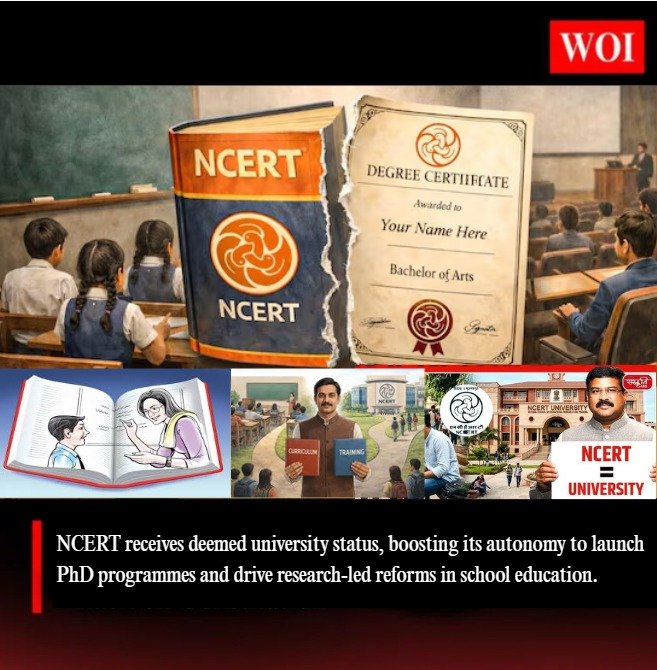
In a landmark reform for school education in India, the Ministry of Education has granted ‘Deemed to be University’ status to the National Council of Educational Research and Training (NCERT). The decision was taken on the recommendation of the University Grants Commission (UGC), placing NCERT in a distinct category of specialised academic institutions.
What the New Status Means
With this recognition, NCERT gains greater academic autonomy. It can now design and offer PhD and advanced research programmes, introduce innovative academic courses, and strengthen its role in education research, curriculum development, and teacher training. The move is expected to transform NCERT into a research-driven institution focused on school education.
Why This Is Important
Granting deemed university status to NCERT aligns with India’s broader education reforms. It will promote evidence-based policymaking, improve the quality of textbooks and learning materials, encourage innovation in teaching methods, and address long-standing challenges in the schooling system through rigorous research.
Role of UGC
The proposal was processed through the UGC portal and evaluated by an expert committee, ensuring that academic standards and regulatory norms are maintained. This structured assessment reinforces the credibility of the reform.
About NCERT
Established in 1961, NCERT is a key institution in India’s education ecosystem. It develops school textbooks, conducts educational research and training, and advises governments on education policies and reforms. Its textbooks form the backbone of school education across the country.
Overall, this decision marks a significant step towards strengthening India’s school education system by integrating research, innovation, and academic excellence at the national level.
