
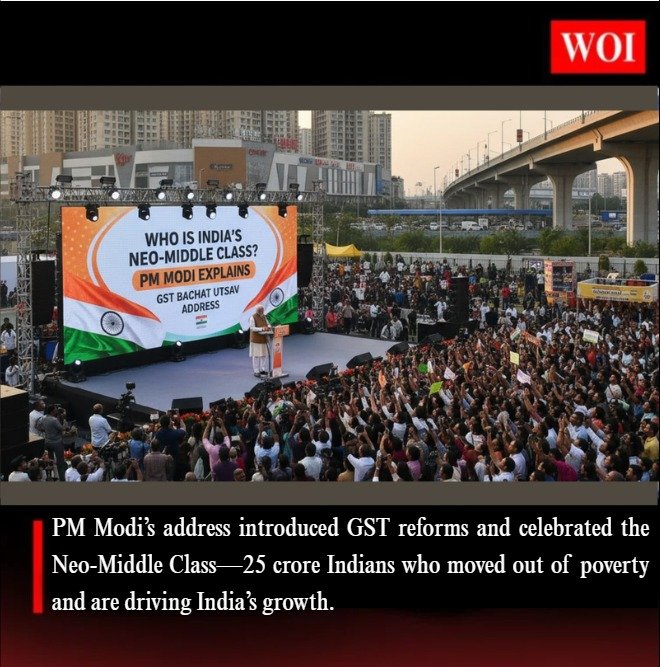
In his national address on 21 September 2025, Prime Minister Narendra Modi unveiled the Next-Generation GST reforms and launched the GST Bachat Utsav, highlighting the rise of the Neo-Middle Class—a group that has recently moved out of poverty and is now shaping India’s future.
Nearly 25 crore Indians have overcome poverty in the last eleven years, forming this aspirational segment. Positioned between the poor and the traditional middle class, they dream of better education, healthcare, housing, and lifestyle. Their spending is cautious yet ambitious, fueling India’s consumption-driven growth.
Government reforms have brought them a double benefit—income up to ₹12 lakh made tax-free and essential goods under a reduced 5% GST slab. This relief not only boosts affordability but also enables investment in homes, vehicles, and education.
The Neo-Middle Class is fast becoming a symbol of India’s progress, bridging rural and urban economies, strengthening local industries, and powering the Made in India movement. For policymakers, they are proof that reforms are translating into real, tangible change in people’s lives.
