
Recent conflicts underscore the rising role of remote warfare, where jets, drones, and missiles rely heavily on satellite navigation systems like GPS, Glonass, Galileo, and BeiDou. However, these systems face increasing threats from jamming, spoofing, and meaconing, making them vulnerable in high-threat environments.
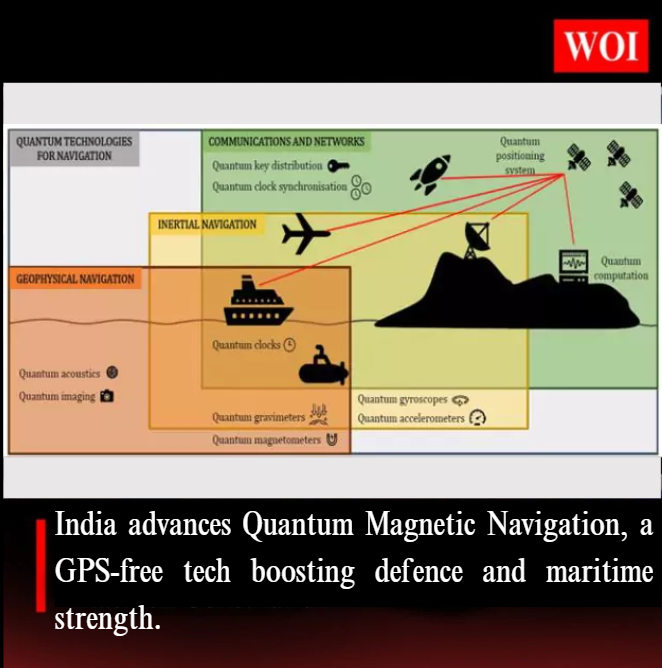
The Quantum Magnetic Navigation System (QMNS) offers a game-changing alternative. Using ultra-sensitive quantum magnetometers, QMNS detects subtle variations in Earth’s magnetic field and matches them with detailed anomaly maps to determine location—without satellite signals. This makes it invaluable for GPS-denied zones, underwater navigation, and deep-sea operations.
Globally, the US, China, UK, and Germany are advancing QMNS for defence platforms, with China already demonstrating submarine-based systems. India, under its ₹6,000 crore National Quantum Mission, is developing indigenous QMNS through DRDO, IIT Bombay, and startups like QuBeats, aiming to boost electronic warfare resilience, maritime security, and the Blue Economy.
By overcoming satellite vulnerabilities, QMNS is set to redefine navigation in both defence and civilian domains.
