
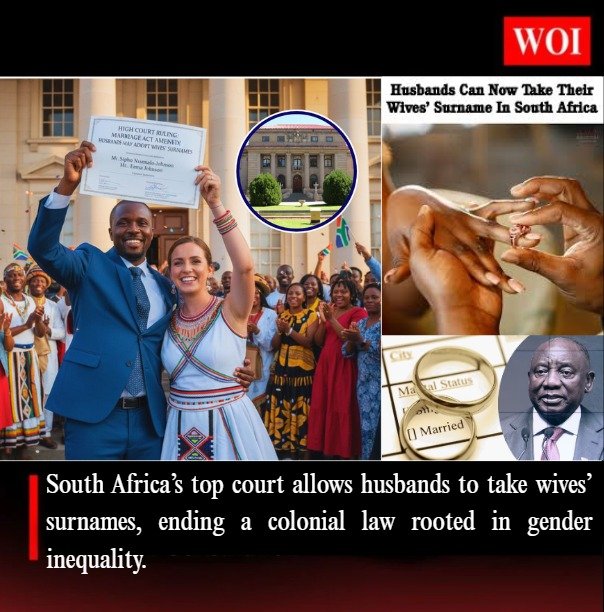
In a landmark ruling, South Africa’s Constitutional Court has overturned a decades-old law that prevented husbands from adopting their wives’ surnames after marriage. The court declared the law unconstitutional, calling it a “colonial import” that perpetuated gender-based discrimination.
The Case
The decision comes after two couples challenged the Births and Deaths Registration Act, which restricted men from taking their spouses’ surnames. The court found that the law unfairly reinforced patriarchal norms and undermined equality within marriage.
Cultural and Historical Context
The judgment highlighted that in many African cultures, women traditionally retained their birth names after marriage. However, these practices were disrupted by the arrival of European colonisers, who imposed Western naming conventions and reinforced male-dominated systems of identity.
Next Steps
Parliament will now be required to amend the Births and Deaths Registration Act and its accompanying regulations to align with the court’s ruling. Until then, the Department of Home Affairs will be expected to facilitate surname changes in line with the new legal interpretation.
Broader Significance
Legal experts and gender rights advocates have hailed the ruling as a step toward dismantling systemic gender inequality. It marks progress not only in protecting personal identity choices but also in restoring cultural practices overshadowed by colonial influence.
As South Africa moves forward with legislative amendments, the ruling is expected to influence wider discussions on family law, identity rights, and cultural recognition in a modern constitutional democracy.
