
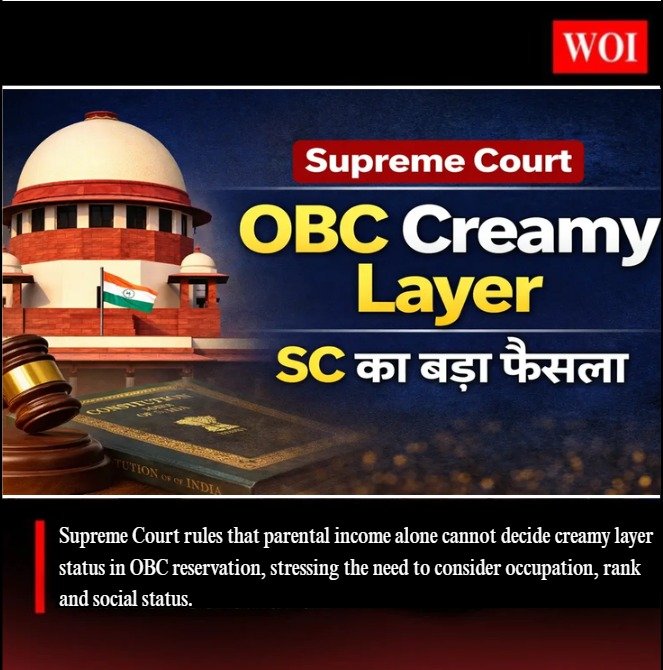
The Supreme Court of India has issued an important clarification regarding the “creamy layer” rule in the Other Backward Classes (OBC) reservation system, stating that parental income alone cannot be the sole criterion for determining creamy layer status. The Court emphasized that authorities must also consider factors such as the nature of employment, social status, and the position held by parents while deciding eligibility for reservation benefits.
The concept of the creamy layer was first introduced in the landmark Indra Sawhney judgment of 1992, which implemented the Mandal Commission recommendations. Under the current system, individuals whose family income exceeds ₹8 lakh per year are generally classified under the creamy layer and are excluded from the 27% OBC reservation in government jobs and educational institutions.
The Court’s clarification came after disputes over how creamy layer status was determined for children of employees working in public sector undertakings (PSUs), banks, and private companies. Earlier, some rules relied mainly on income, which created inconsistencies in how candidates from different employment backgrounds were treated.
According to the Supreme Court, economic income alone does not necessarily reflect social advancement, and therefore multiple factors must be considered when identifying creamy layer status. The ruling also stresses that children of government employees, PSU staff, and private sector workers should be treated equally in this assessment.
The judgment aims to ensure that reservation benefits reach genuinely disadvantaged sections within the OBC community. It may lead to revised guidelines for determining creamy layer status, incorporating both income levels and the social position of parents to ensure a fairer and more balanced system.
