
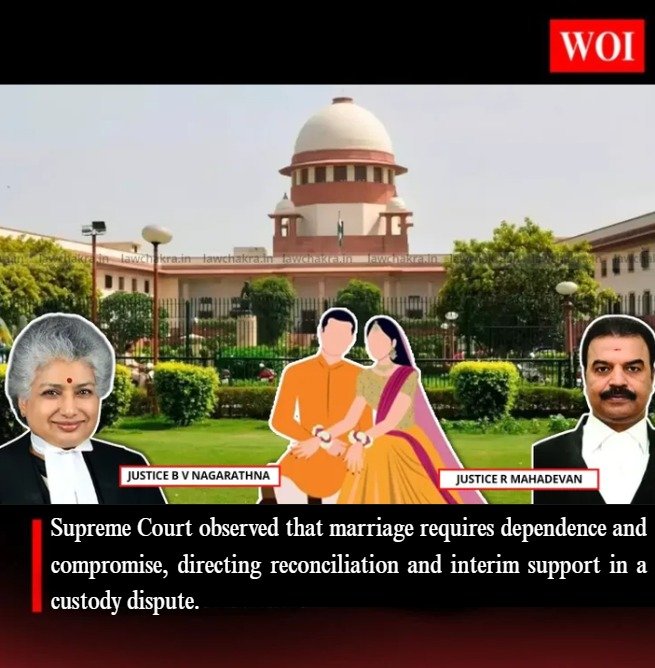
Judicial Observation
The Supreme Court of India recently observed that “complete independence in marriage is impossible”. The bench emphasised that marriage is based on mutual dependence, compromise, and shared responsibility, rather than complete individuality.
Case Background
The observation came during the hearing of a marital dispute where:
- The wife sought independence from her husband.
- The husband sought custody of their children.
The case highlighted the tension between personal freedom and family responsibilities.
Court’s Directions
The bench, comprising Justice B.V. Nagarathna and Justice R. Mahadevan, issued the following directions:
- The husband must pay ₹5 lakh as interim maintenance to his wife.
- The father was granted temporary custody of his son on his birthday, balancing compassion with parental rights.
Emphasis on Reconciliation
The Court stressed that reconciliation is crucial, especially for the welfare of children. It noted that while spouses may pursue personal ambitions, marriage requires:
- Emotional and financial interdependence
- Adjustment and compromise
- Consideration of children’s future and upbringing
Broader Implications
This observation reflects the Court’s stance that marriage in Indian society cannot be seen through the lens of complete autonomy. Instead, it should be viewed as:
- A partnership of equals with shared duties
- A foundation for family stability
- A responsibility towards children’s growth and protection
By urging the couple to reconcile and prioritise their children’s welfare, the Supreme Court reinforced that family harmony and children’s best interests must remain central in marital disputes.
