
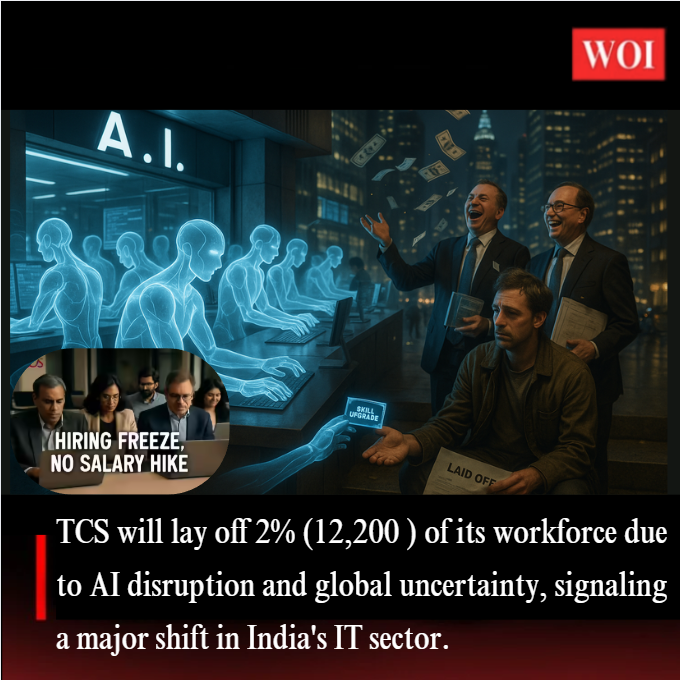
In a significant move reflecting broader industry trends, Tata Consultancy Services (TCS) has announced that it will lay off approximately 2% of its global workforce—over 12,200 employees—primarily in middle and senior management roles. This strategic decision is part of TCS’s “journey to become a future-ready organisation” amid economic pressures and technological disruptions.
The layoff decision follows lower-than-expected revenue in the first quarter of the fiscal year, driven by subdued discretionary spending and global geopolitical tensions that have weakened demand for IT services. As of June, TCS reported a global headcount of 6,13,000.
Shifting Priorities and Global Headwinds
Experts link the decision to a broader shift in how IT companies are reassessing their workforce in the wake of emerging technologies like AI, and shifting client preferences—particularly from US-based clients. According to Rajesh Palviya, Senior Vice-President and Head of Research at Axis Securities, clients now prefer a US-centric approach, reducing outsourcing to countries like India. Furthermore, AI automation is replacing traditional roles, especially in assignments and projects, causing companies to feel “over-hired.”
No Surge in New Orders
Adding to the concerns, Palviya also noted that order flows for IT firms showed no significant uptick in the recent quarter. Many companies issued conservative forward guidance, highlighting a general lack of optimism.
Risks to Mid-Level Roles
Shubham Rathore, Principal Analyst at Gartner, emphasized that persistent low business sentiment in Europe, combined with geopolitical instability, poses long-term risks. As a result, companies may increasingly rely on AI-driven solutions, putting mid-level roles—such as system analysts and module leads—at risk. However, higher management roles like team leaders and project managers are expected to remain essential.
A Departure from Past Practices
Historically, Indian IT firms have been resilient against layoffs, even during technological disruptions. However, that trend has changed. In 2023, Cognizant laid off 3,500 employees due to falling revenues, and in April 2025, Infosys announced a layoff of 195 employees. Analysts suggest that such developments signal a paradigm shift, influenced by macroeconomic slowdowns and the accelerated pace of AI adoption.
Concerns Over Ethical Practices
Experts have also raised ethical concerns over abrupt, large-scale layoffs. Terminating thousands of employees without offering reskilling or redeployment options, or even voluntary separation, is viewed as a violation of the core values of job security and corporate social responsibility.
