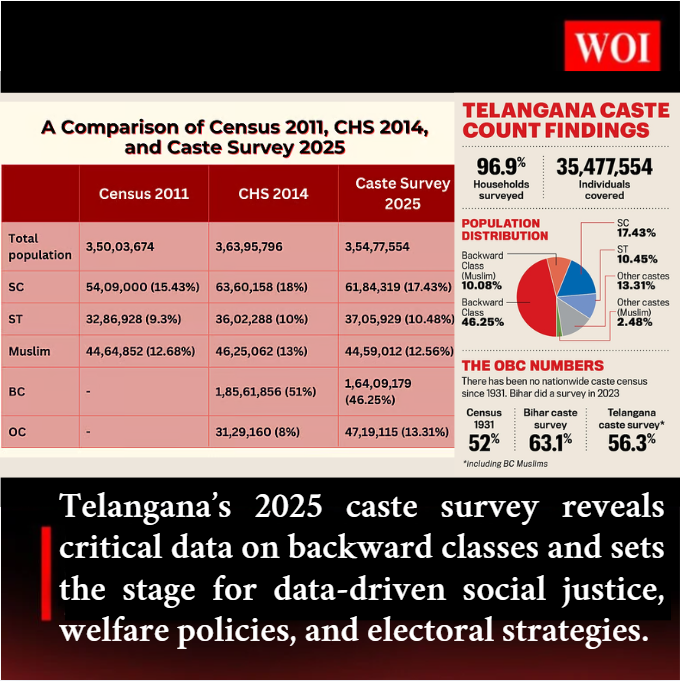
The Justice Sudarshan Reddy Committee recently submitted the findings of Telangana’s caste survey to Chief Minister Revanth Reddy, covering 1.15 crore households and over 3.55 crore individuals across the state. The comprehensive survey offers crucial insights into caste demographics and socio-economic disparities, forming a foundation for targeted welfare policies.
Key Findings:
- Backward Castes (BCs): 56.3%
- Scheduled Castes (SCs): 17.4%
- Scheduled Tribes (STs): 10.4%
- Other Castes (OCs): 15.9%
The data is disaggregated by gender and geography (urban/rural), enhancing its value for policy-making. Dubbed a “Mega Health Check-up” for marginalized communities, the survey is expected to guide welfare decisions based on concrete socio-economic realities.
Need for Updated Caste Data:
India lacks updated OBC data since the 1931 Census. Despite the 2011 SECC being conducted, its socio-economic data remain unreleased. As a result, state-led surveys like Telangana’s and Bihar’s (2023) have become essential for bridging this data gap.
Legal and Constitutional Backing:
Articles 15(4) and 16(4) of the Indian Constitution empower the state to make special provisions for socially and educationally backward classes. The Indra Sawhney v. Union of India (1992) judgment emphasized that such reservations must be based on quantifiable data and capped backward class reservations at 50%.
Advanced Analysis and Intersectionality:
The survey highlights how caste overlaps with gender, location, and other factors to create compounded disadvantages. For instance, tribal women in rural areas may face greater educational and employment barriers than urban OBC men. These findings are critical for designing more inclusive and intersectional development policies.
Political and Administrative Implications:
The survey is expected to reshape the political landscape. Key outcomes could include:
- Demands for OBC sub-categorization
- Revised quotas based on updated data
- Budget reallocations targeting the most marginalized
- Influence on electoral boundaries through geographic caste data
- Political outreach strategies tailored to community needs
Such granular data may also spark conversations about a national caste census and drive future state-led initiatives aimed at promoting equity.
