
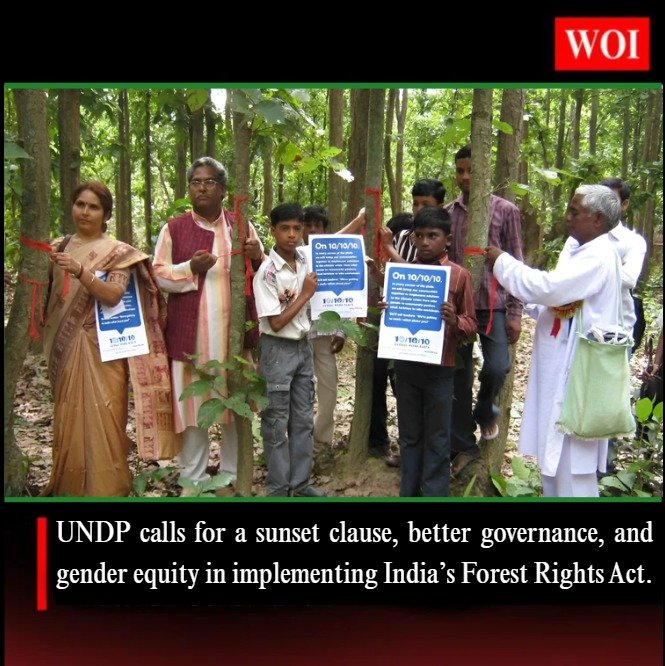
The United Nations Development Programme (UNDP) report of 2025 highlights key challenges in the implementation of India’s Forest Rights Act (FRA), 2006. While the Act has distributed titles over 2.32 crore acres, this covers only 18% of the potential 9.88 crore acres eligible for community rights.
The report calls for a sunset clause to set an end date for recognising and vesting rights, urging better record-keeping and governance. States like Chhattisgarh, Maharashtra, and Odisha acknowledged lapses in title recognition and the need for centralised data systems.
Conflicts between tribal welfare and forest departments remain a hurdle. The report recommends high-level committees for coordination and integration of Gram Sabha forest plans with department working plans.
Gender equity is emphasised, with suggestions to collect gender-disaggregated data, promote women’s leadership in forest management, and link FRA to NRLM for livelihood support.
The UNDP also calls for a National Tribal Policy, funding support under Article 275(1), and stronger alignment of FRA with PESA and other tribal laws. Additionally, it stresses recognising forest communities’ rights over biodiversity and traditional knowledge while clarifying ownership and sale policies for minor forest produce.
With these measures, the FRA could move from delayed implementation to becoming a strong framework for tribal rights, livelihoods, and sustainable forest governance.
