
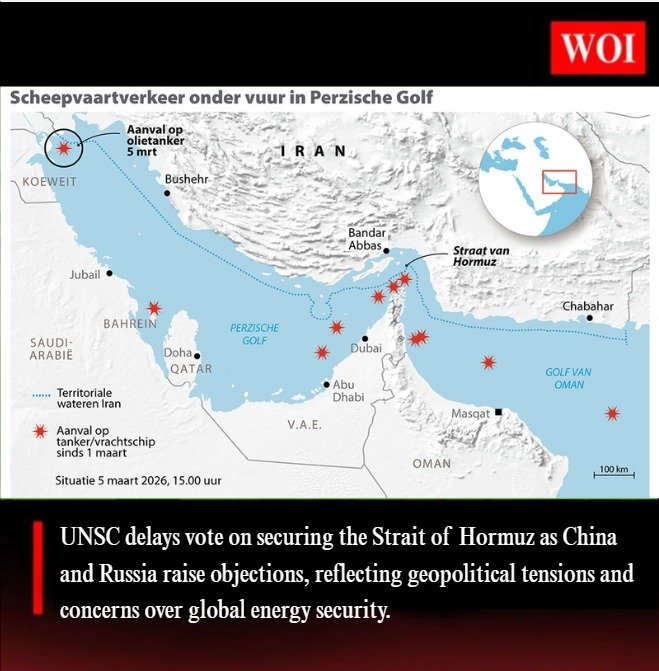
The United Nations Security Council has once again postponed its vote on a draft resolution aimed at securing the Strait of Hormuz, with the decision now expected next week. The delay follows continued diplomatic disagreements among major global powers, underlining the sensitivity of the issue and its far-reaching geopolitical consequences.
The resolution, proposed by Bahrain in its role as UNSC chair, has faced objections from China and Russia during negotiations. These differences led to repeated revisions, softening the language of the draft from stronger enforcement provisions to a more limited mandate. The revised text authorises the use of “all defensive means necessary” to protect commercial shipping but removes explicit binding enforcement clauses.
The Strait of Hormuz is one of the world’s most critical maritime routes, handling nearly 20% of global oil trade. Any disruption could have serious implications for global energy markets and international trade. The United States and several Gulf nations support the resolution, viewing it as essential to maintaining freedom of navigation amid rising regional tensions involving Iran.
The postponement highlights the difficulty of achieving consensus within the UNSC, where competing strategic interests often shape outcomes. It also reflects broader power rivalries that complicate collective security decisions in geopolitically sensitive regions. As negotiations continue, the eventual vote will be closely watched for its impact on regional stability and global energy security.
