
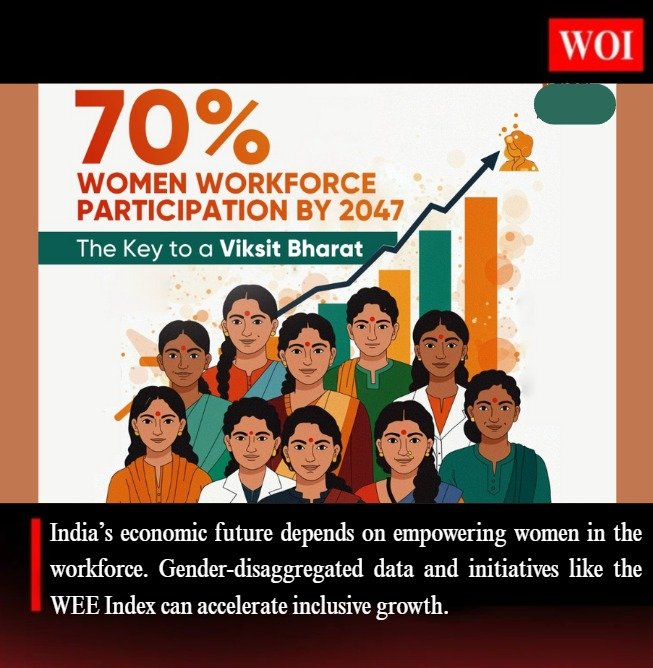
India’s economic growth depends on fully including women in the workforce. At present, women contribute just 18% to GDP, with nearly 196 million employable women outside the labour force. While female labour participation has improved to 41.7%, few women hold formal jobs—posing a challenge to India’s $30 trillion economy vision by 2047.
Role of Gender-Disaggregated Data
India collects vast statistics, but rarely by gender. The Women’s Economic Empowerment (WEE) Index, launched in Uttar Pradesh, highlights barriers across employment, skilling, entrepreneurship, mobility, and safety. For instance, though women enrol strongly in skilling programmes, few access credit or become entrepreneurs.
Targeted Interventions
Data-driven policies have improved recruitment of women bus drivers and facilities like restrooms at bus terminals. Similar gender-specific approaches in housing, transport, MSMEs, and education can bridge structural gaps.
Rethinking Gender Budgeting
Gender budgeting must go beyond welfare schemes. Applying a gender lens across all sectors ensures resources reach women where needed most.
Scaling Across States
Uttar Pradesh’s WEE Index can serve as a model for states like Maharashtra, Odisha, and Telangana to design district-level action plans, boosting female workforce participation and inclusive growth.
The Road Ahead
Empowering women through data visibility, targeted policies, and fair budgeting is critical. By making women central to governance and growth, India can unlock its demographic dividend and achieve sustainable economic progress.
