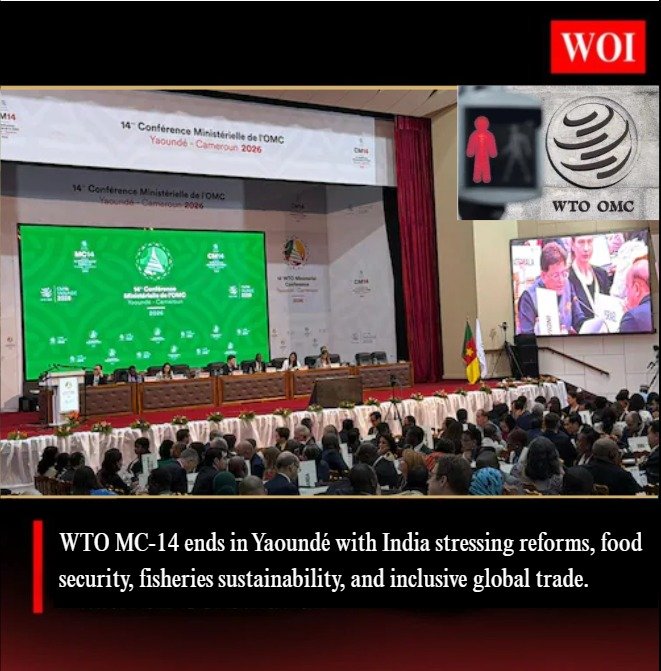
The 14th Ministerial Conference (MC-14) of the World Trade Organization (WTO) concluded on 30 March 2026 in Yaoundé, Cameroon, bringing together global trade leaders to deliberate on key challenges facing the international trading system.
India, represented by Commerce and Industry Minister Piyush Goyal, played an active role in shaping discussions on WTO reforms, fisheries subsidies, agriculture, e-commerce, and development concerns, with a strong emphasis on fairness and inclusivity for developing and least-developed countries.
Key Outcomes of MC-14
The conference witnessed progress on several fronts, though many negotiations remain unresolved. WTO members agreed to continue talks on fisheries subsidies, with expectations of concrete outcomes at MC-15. Decisions were also adopted to support small and vulnerable economies, alongside efforts to strengthen the implementation of Sanitary and Phytosanitary (SPS) and Technical Barriers to Trade (TBT) agreements.
However, persistent differences among members highlighted the growing complexity of achieving consensus in global trade negotiations.
India’s Stand
India reaffirmed that consensus-based decision-making is the cornerstone of the WTO. It underscored the need for transparent and inclusive reforms, resolution of food security and public stockholding (PSH) issues, and urgent restoration of the dispute settlement mechanism.
On fisheries, India stressed a people-centric approach, noting that millions depend on small-scale fishing for livelihoods and that sustainability concerns should primarily address large industrial fleets.
Agriculture and Digital Trade
India strongly advocated for food security, a permanent solution on PSH, the Special Safeguard Mechanism (SSM) for farmers, and addressing cotton subsidies affecting developing nations. On e-commerce, no consensus was reached on customs duties for electronic transmissions, with India highlighting the need to bridge the digital divide and ensure equitable participation in digital trade.
About the WTO Ministerial Conference
The WTO Ministerial Conference is the organization’s highest decision-making body, held every two years, and plays a crucial role in setting global trade rules, negotiating agreements, and addressing policy and dispute-related issues.
