
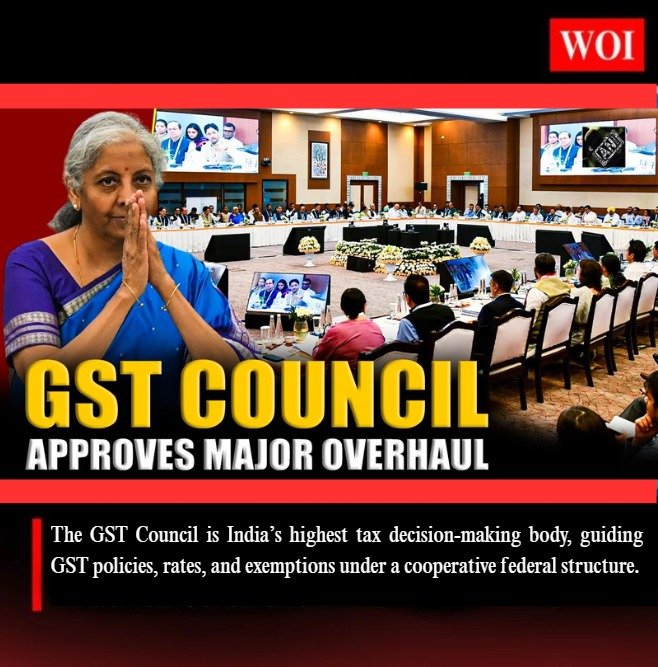
The Goods and Services Tax (GST) Council is India’s highest decision-making body on GST matters. Established under the 101st Constitutional Amendment Act, 2016, through Article 279A, it ensures cooperative federalism by uniting the Union and State governments to decide GST policies, rates, and exemptions.
Constitutional Basis
The GST Council’s powers come directly from the Constitution. It recommends taxes to be merged under GST, items to be taxed or exempted, GST rates, and special provisions for states. It also has authority to resolve disputes between the Centre and States.
Composition
- Chairperson: Union Finance Minister
- Vice-Chairperson: Chosen from State Finance Ministers
- Members: State Finance/Tax Ministers & Union MoS for Finance/Revenue
- Others: CBIC Chairperson (permanent invitee) and Union Revenue Secretary (ex-officio secretary)
Functions
The Council makes key decisions on GST laws, rate structures, exemptions, ITC, compliance systems, and special provisions for certain states.
Working
- Quorum: Half the members must be present
- Voting: Centre holds one-third weight; States collectively hold two-thirds. Decisions need a three-fourths majority.
Achievements
The Council has introduced the dual GST model, ITC, composition schemes for small businesses, online compliance systems, and regular rate rationalisation to simplify India’s tax structure.
The GST Council continues to play a vital role in shaping India’s unified tax regime and promoting a seamless national market.
