
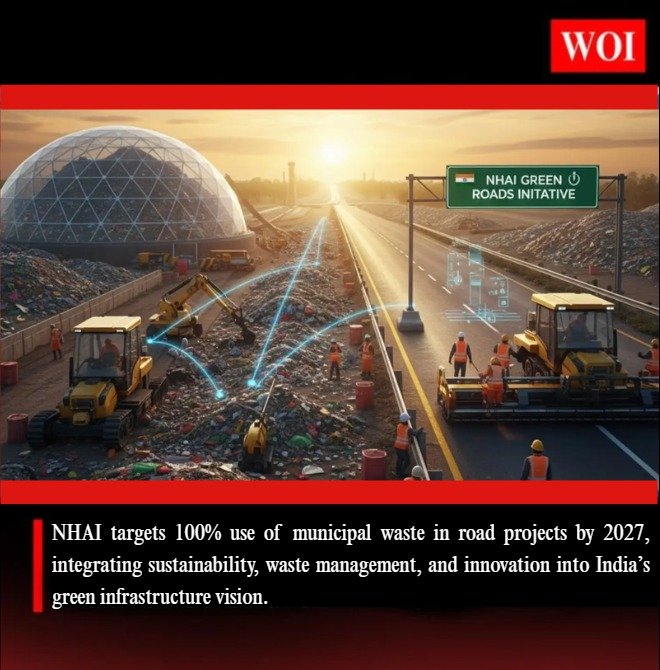
In a landmark move toward sustainable infrastructure, the National Highways Authority of India (NHAI) plans to utilise 100% of India’s municipal waste for road construction by 2027, as announced by Union Road Transport and Highways Minister Nitin Gadkari during a convocation ceremony near Chennai. The initiative aims to tackle urban waste challenges while reducing dependence on carbon-intensive construction materials.
Currently, over 80 lakh tonnes of municipal waste are being used in national highway projects — including 25 lakh tonnes on the Ahmedabad–Pune Highway and 40 lakh tonnes on the Mumbai–Delhi Expressway. These efforts highlight India’s growing capacity to transform urban waste into valuable construction material.
The 2027 target reflects India’s commitment to a circular economy, sustainable infrastructure, and the Sustainable Development Goals (SDGs), particularly those related to industry innovation (SDG 9) and responsible consumption (SDG 12).
In a major innovation, Gadkari announced the successful development of bio-bitumen made from livestock waste, which has shown superior performance to petroleum-based alternatives. Certified by the Central Research Organisation, this technology reduces fossil fuel dependence and lowers carbon emissions.
Additionally, research is underway to produce hydrogen from municipal waste, paving the way for clean energy generation under India’s green hydrogen mission.
By turning waste into roads and clean fuel, India is charting a sustainable path where innovation meets environmental responsibility — setting a global example in green infrastructure and resource efficiency.
