
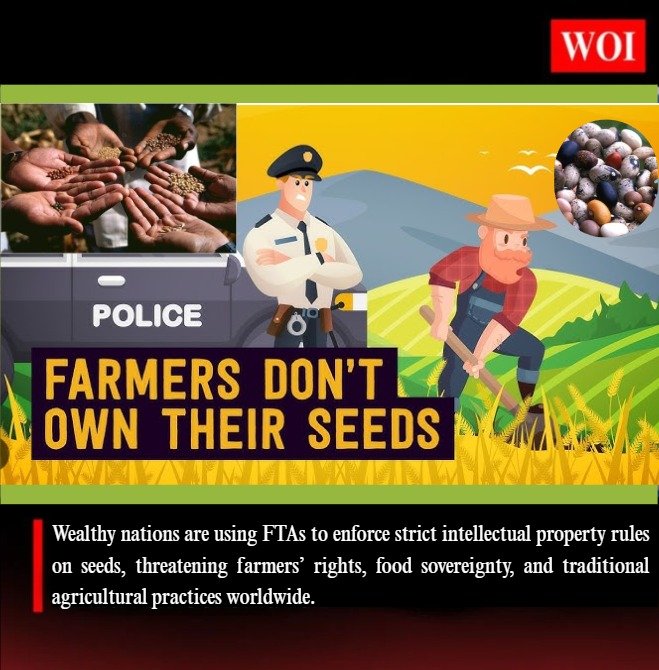
FTAs Used to Enforce Strict Seed IP Rules, Threatening Farmers’ Rights Globally
Recent reports reveal that free trade agreements (FTAs) are increasingly being used by wealthy nations to impose strict intellectual property (IP) rules on seeds and biodiversity. These rules, often aligned with the 1991 UPOV Convention, grant companies exclusive rights over new crop varieties for 20–25 years, preventing farmers from saving and reusing seeds and undermining traditional farming practices.
FTAs, negotiated outside the WTO framework, often push countries in the global South to adopt these restrictive standards. Key players enforcing UPOV-aligned rules include the United States, European Union, Australia, Japan, and increasingly, the United Arab Emirates, which has incorporated such clauses in agreements with Cambodia, Malaysia, and Mauritius. India, however, has resisted such pressure.
The trend threatens food sovereignty, giving corporations monopoly control over seeds and prioritising industrial agriculture over traditional farming systems. Additional FTA measures, such as plant patent laws and adherence to the Budapest Treaty, extend corporate control over biodiversity while bypassing democratic debate.
A newly updated global dataset maps two decades of FTAs with UPOV-style clauses, highlighting the scale and spread of this growing influence on agricultural policies worldwide.
