
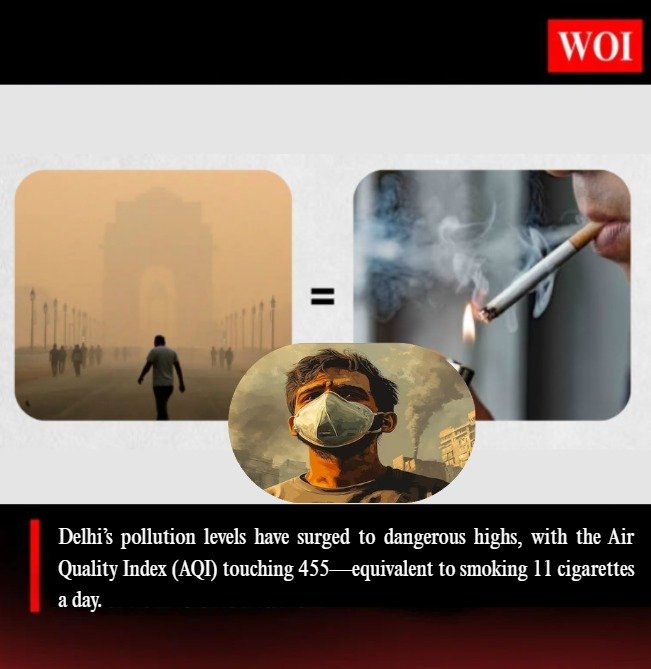
Delhi’s air pollution crisis has taken a grave turn, with pollution levels climbing steadily despite multiple interventions. The national capital woke up on Friday to a thick blanket of smog as the Air Quality Index (AQI) touched an alarming 455, marking one of the worst pollution days of the season. According to air quality tracker aqi.in, breathing Delhi’s air today is equivalent to smoking nearly 11 cigarettes.
Cloud Seeding Experiment Fails to Bring Relief
In a bid to artificially induce rainfall and reduce pollution, the Delhi government carried out an expensive cloud-seeding operation. However, the experiment failed, offering no respite to the choking city and raising concerns about the effectiveness of such high-cost measures.
Different Systems, Alarming Numbers
Multiple monitoring systems reported severe air quality early Friday morning:
- AQI: 455 at 7 AM (aqi.in)
- AQI: 433 at 5 AM (aqi.in)
- AQI: 373 at 5:30 AM (Early Warning System for Delhi)
The difference in readings stems from varying device networks, monitoring stations and computational parameters used by the two systems. Despite the variations, all reports confirm Delhi’s air remains dangerously toxic.
Pollutant Levels Far Above Global Safety Limits
Key pollutants have crossed limits by shocking margins:
- PM 2.5: 280 µg/m³
(WHO safe limit for 24 hours: 15 µg/m³) - PM 10: 370 µg/m³
(WHO safe limit: 45 µg/m³)
Exposure to such concentrations poses severe health risks, including respiratory distress, cardiovascular issues, decreased lung function and long-term chronic conditions.
GRAP Stage-III Enforced
The Commission for Air Quality Management (CAQM) has activated the Graded Response Action Plan Stage-III (GRAP-3), a strict emergency protocol implemented when AQI breaches the 401–450 range or is projected to do so.
Under GRAP-3:
- Construction activities (excluding essential projects) are restricted.
- Diesel generators are banned except for emergency services.
- Pollution-emitting vehicles face stricter checks.
- Industrial operations using unclean fuels face curbs.
Despite GRAP-3 enforcement, pollution persists due to stagnant weather conditions, vehicular emissions, stubble burning and urban congestion.
A Public Health Emergency
Doctors have urged people—especially children, elderly and those with heart or lung conditions—to stay indoors. Experts warn that prolonged exposure could lead to irreversible damage.
As air quality deteriorates, Delhiites brace for another difficult week, questioning how long the city can continue battling this annual environmental and health disaster.
