
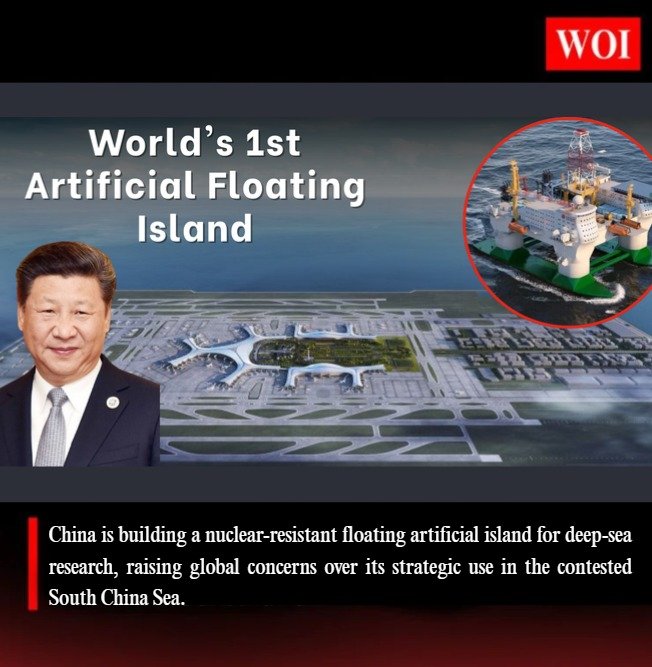
China has initiated construction of a massive mobile floating artificial island aimed at boosting long-term deep-sea research and strengthening its maritime presence. Expected to be fully operational by 2028, the project has attracted global scrutiny due to its scale, technology and potential geopolitical impact in the South China Sea.
A Futuristic Deep-Sea Platform
Officially named the Deep-Sea All-Weather Resident Floating Research Facility, the 78,000-tonne platform will feature a semi-submersible twin-hull design. It will be capable of hosting 238 personnel for up to four months without resupply, with its 138m × 85m structure standing 45m above sea level—allowing it to withstand harsh weather, including strong tropical cyclones.
Engineered for Extreme Survival
One of the most notable features is its nuclear-blast-resistant construction. Engineers are using an advanced microscopic lattice made of folded metal tubes arranged in precise geometric patterns. This design compresses under shock, increasing density and providing exceptional impact absorption. The island will be equipped with emergency power systems, secure communication networks and advanced navigational stabilisers.
Strategic Implications
Although China frames the facility as a scientific research platform, its location in the disputed South China Sea has raised concerns. With endurance capabilities surpassing most naval vessels, experts believe the floating island could serve dual purposes—supporting scientific missions while also enabling surveillance, logistics support and extended maritime operations under a civilian façade.
The project underscores China’s growing push for technological dominance in marine infrastructure and its strategic positioning in contested waters.
