
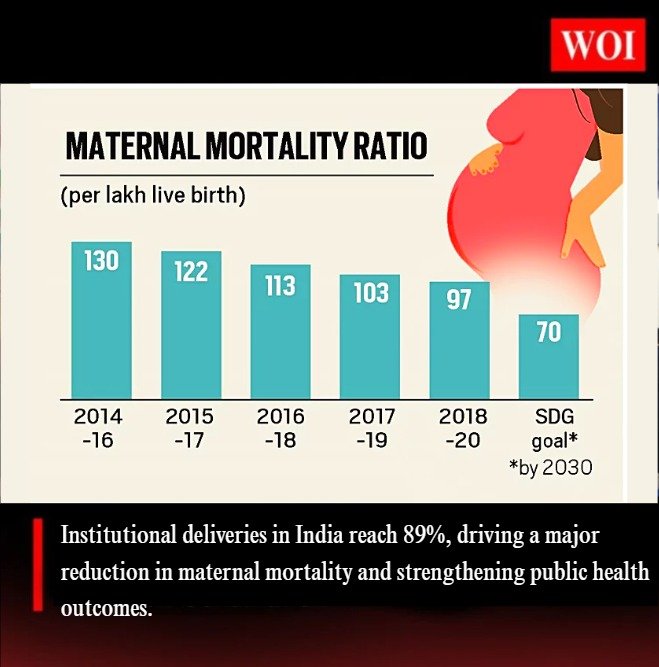
India has achieved notable progress in improving maternal health outcomes, with institutional deliveries rising to 89%, according to the Ministry of Health and Family Welfare. This increase has played a crucial role in reducing the Maternal Mortality Ratio (MMR), marking a major public health milestone for the country.
Maternal mortality refers to the death of a woman during pregnancy or within 42 days of its termination due to pregnancy-related causes. India’s MMR declined from 130 per 1,00,000 live births in 2014–16 to 97 in 2018–20, reflecting improved access to skilled care and health facilities. Institutional deliveries rose from 79% in 2015–16 to 89% in 2019–21, with states such as Kerala, Goa, Tamil Nadu, Puducherry, and Lakshadweep achieving 100% coverage.
Institutional delivery ensures skilled medical supervision, timely management of complications, and access to emergency obstetric care, making it one of the most effective strategies to reduce maternal and newborn deaths. Coverage stands at nearly 87% in rural areas and 94% in urban areas, highlighting improved healthcare reach across regions.
Despite these gains, challenges remain, including high out-of-pocket expenses, sociocultural barriers, rising high-risk pregnancies, and gaps in infrastructure in remote and tribal regions. To address these, the government has implemented schemes such as Janani Suraksha Yojana, Pradhan Mantri Matru Vandana Yojana, PMSMA, LaQshya, and Maternal Death Surveillance Review, alongside digital tracking and capacity-building initiatives.
India’s steady progress brings it closer to the SDG 3.1 target of reducing MMR below 70 by 2030, while underscoring the need for continued focus on equity, quality of care, and last-mile health infrastructure.
#WordOfIndia #WOI #MaternalHealth #InstitutionalDeliveries #MaternalMortality #MMR #PublicHealthIndia #WomenHealth #SafeMotherhood #SDG3 #HealthForAll #RuralHealthcare #UrbanHealthcare #JSY #PMMVY #PMSMA #LaQshya #HealthcareReforms
