
By Soniya:
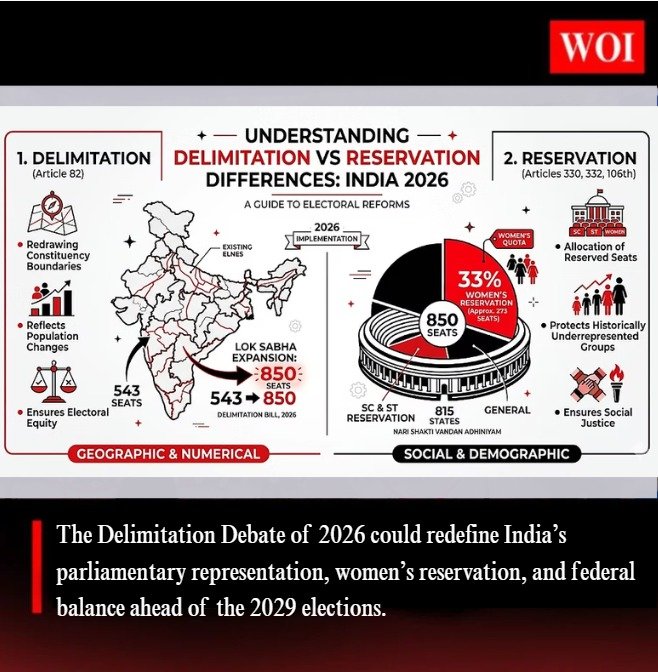
India is witnessing one of its most consequential democratic debates in decades as Parliament takes up the Delimitation Bills in April 2026. At the heart of the discussion lies a proposal to redraw electoral boundaries, expand the Lok Sabha from 543 to 850 seats, and fast-track the implementation of 33% women’s reservation using 2011 Census data.
Delimitation aims to uphold the principle of “one person, one vote” by ensuring equal representation based on population. However, India’s constituency map has remained frozen since 1971 to avoid penalising states that successfully controlled population growth. The new bills seek to end this freeze, arguing that a modern democracy cannot function on outdated demographics.
The immediate trigger is women’s reservation. Under existing law, it could only be implemented after the next census, potentially delaying it until 2034. The government’s move to use the 2011 Census is intended to ensure women get reserved seats by the 2029 general elections.
Supporters say the reforms will improve governance, reduce the burden on MPs, and correct decades of representational imbalance. Critics, however, warn that population-based redistribution could shift political power toward northern states, weakening the federal balance and marginalising southern states that performed well in family planning.
With concerns over parliamentary balance, Rajya Sabha’s role, and the absence of explicit constitutional safeguards for states, the debate has become both legal and emotional. As Parliament prepares to vote, the delimitation exercise stands as a defining moment—one that could reshape India’s democracy for generations to come.
