
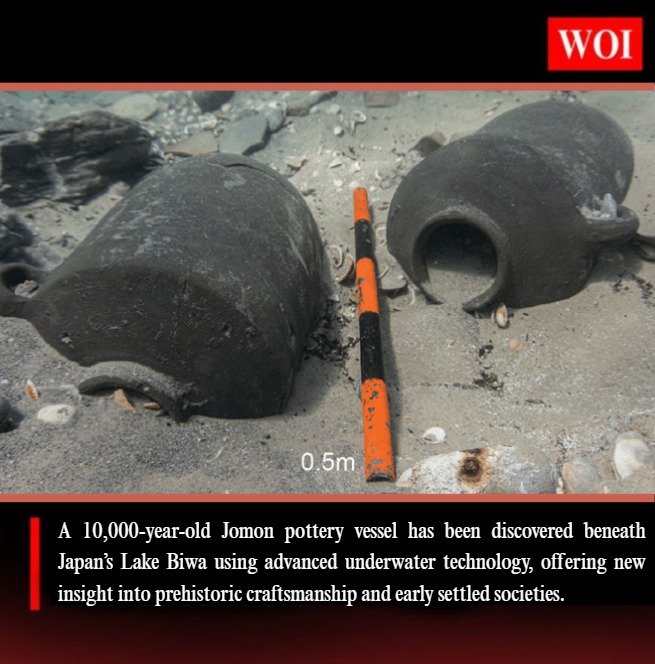
A groundbreaking archaeological find beneath Japan’s Lake Biwa has revealed one of the world’s oldest and best-preserved pottery vessels, dating back over 10,000 years to the early Jomon period. Recovered from the Tsuzuraozaki underwater ruins at a depth of 64 metres, the 25-centimetre-tall vessel offers rare insight into prehistoric craftsmanship and early settled communities in Japan.
Jomon pottery is among the earliest known ceramic traditions in human history, marking a shift from nomadic lifestyles to settled societies. The newly discovered vessel, believed to belong to the Jinguji-style or Konami Upper-layer tradition, features refined engravings that highlight the aesthetic and cultural sophistication of ancient Jomon communities.
The excavation was made possible using advanced underwater technologies, including autonomous underwater vehicles (AUVs) and high-resolution 3D sonar mapping. These innovations are transforming underwater archaeology, enabling researchers to safely explore deep, previously inaccessible heritage sites.
The Tsuzuraozaki site, explored for nearly a century, has yielded more than 200 pottery fragments, yet its purpose remains a mystery. The upright positioning of the intact vessel has sparked new theories—from ancient lakeside habitation to ritual offerings. Ongoing studies aim to uncover how early Jomon people lived and interacted with the landscape surrounding Lake Biwa thousands of years ago.
