
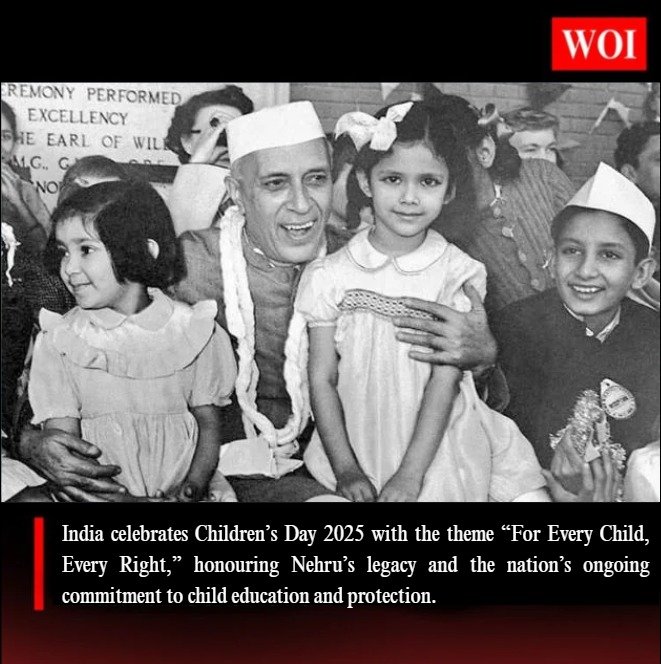
Children’s Day is celebrated every year on 14 November, marking the birth anniversary of Pandit Jawaharlal Nehru, India’s first Prime Minister and a lifelong advocate for children’s rights and education. Before 1964, India observed Children’s Day on November 20, in line with the UN’s Universal Children’s Day. After Nehru’s passing, the date was shifted to honour his deep affection for children, who lovingly called him ‘Chacha Nehru’.
The official theme for Children’s Day 2025 is “For Every Child, Every Right”, emphasizing equal opportunity, protection, and empowerment for every child in the country. Schools and institutions across India celebrate the day with cultural programs, awareness events, and activities highlighting children’s welfare.
Pandit Nehru believed that the nation’s progress depended on nurturing young minds with quality education, scientific thinking, and emotional development. His vision helped establish some of India’s most important educational institutions, including IITs, AIIMS, NITs, and UGC.
India continues to uphold children’s rights through major initiatives such as ICDS, the Mid-Day Meal Scheme, the Right to Education Act, Beti Bachao Beti Padhao, and PM POSHAN. Constitutional protections like Article 21A (Right to Education), Article 24 (ban on child labour), and laws such as the JJ Act and POCSO Act safeguard children’s safety, dignity, and future.
Children’s Day 2025 stands as a reminder of India’s commitment to building a nation where every child is educated, protected, and empowered to thrive.
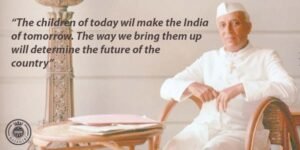
Important Facts About Jawaharlal Nehru
- Born on 14 November 1889 in Allahabad.
- First Prime Minister of independent India (1947–1964).
- Popularly called “Chacha Nehru” for his affection toward children.
- Key architect of modern India’s institutions: IITs, AIIMS, UGC, NITs.
- Strong advocate of scientific temper, secularism, and democratic governance.
- Author of famous works: “Discovery of India,” “Glimpses of World History,” “An Autobiography.”
- Awarded the Bharat Ratna in 1955.
Pandit Nehru’s Role in the Freedom Struggle
1. Joined Indian National Movement
- Inspired by Mahatma Gandhi in 1919.
- Left his legal career and dedicated his life to the freedom struggle.
2. Leader in Non-Cooperation & Civil Disobedience Movements
- Played a key role in mobilising students and youth during the Non-Cooperation Movement (1920).
- Led mass protests during the Civil Disobedience Movement (1930) and Salt Satyagraha support campaigns.
3. Advocate of Complete Independence
- Became Congress President in 1929 and declared Purna Swaraj (Complete Independence) as India’s goal.
- Unfurled the tricolour at Lahore on 31 December 1929.
4. Multiple Imprisonments
- Imprisoned nine times by the British.
- Spent almost nine years in jail between 1921 and 1945.
5. Quit India Movement (1942)
- One of the foremost leaders arrested during the Quit India Movement.
- His imprisonment strengthened the movement’s resolve.
6. International Voice for India
- Advocated India’s anti-colonial vision on global platforms.
- Supported socialist, secular and democratic principles for independent India.
7. Key Role in Drafting India’s Future
- Deeply involved in Constituent Assembly debates.
- Laid the foundation for India’s foreign policy: Non-Alignment Movement (NAM).
