
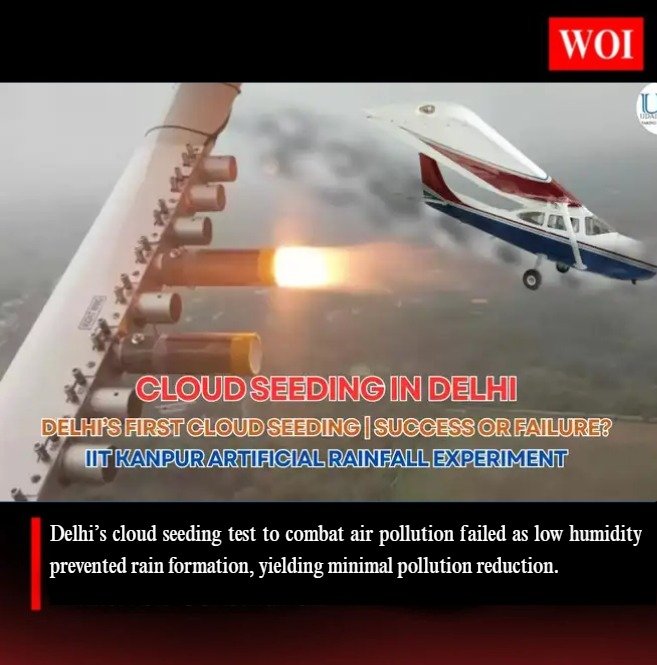
Delhi’s Cloud Seeding Experiment Fails to Produce Artificial Rain
Delhi’s much-anticipated cloud seeding experiment to generate artificial rain and combat toxic air pollution ended with limited success, as atmospheric conditions failed to support rainfall formation. Conducted using a Cessna aircraft dispersing salt-based and silver iodide flares, the operation targeted regions including Khekra, Burari, Karol Bagh and Mayur Vihar.
Aims and Execution
Part of Delhi’s anti-pollution strategy, the trials sought to induce rain capable of washing away harmful PM2.5 and PM10 particles. Up to five rounds were planned, but only two were executed due to poor cloud conditions.
Scientific Limitations
The experiment’s failure was largely due to low humidity levels (10–15%) and insufficient cloud moisture, both crucial for rain formation. Though clouds appeared visible, they lacked the vertical growth and liquid water content needed for effective condensation. Despite proper seeding with 2–2.5 kg flares, the atmosphere was not conducive to precipitation.
Marginal Impact on Pollution
While no measurable rainfall occurred, minor pollution reductions were noted in select areas. PM2.5 levels dipped from 221 to 207, and PM10 from 207 to 177 immediately after seeding. Light traces of rain—0.1 mm in Noida and 0.2 mm in Greater Noida—suggested limited localised effects.
Exam-Oriented Facts
- Cloud seeding uses silver iodide or salt particles to trigger condensation.
- Delhi’s trials marked India’s first large-scale effort for pollution control via artificial rain.
- Moisture below 30% significantly reduces seeding effectiveness.
- Aircraft operated from Kanpur and Meerut, covering multiple Delhi sectors.
Future Outlook
Experts emphasize that cloud seeding success depends heavily on meteorological timing. Future attempts should coincide with higher humidity and favourable cloud profiles. While artificial rain can offer short-term relief, tackling Delhi’s pollution crisis will ultimately require sustained emission control, stubble management, and cleaner transport solutions.
