
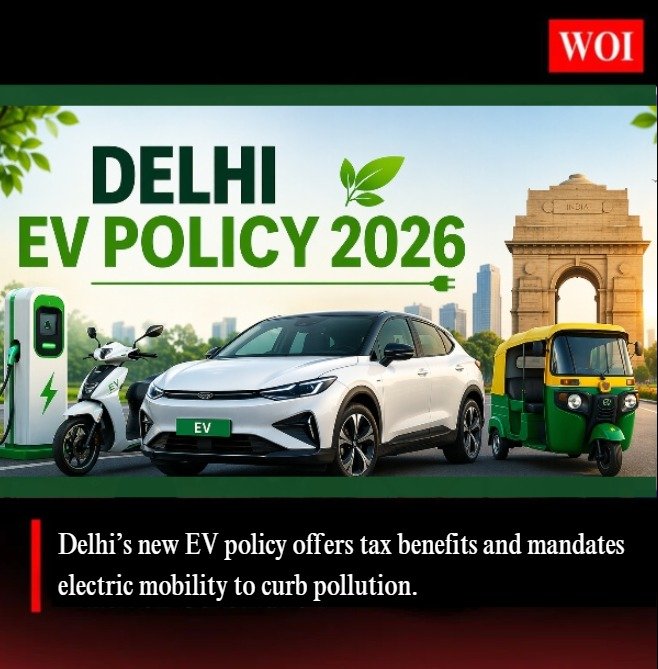
The Delhi Government has unveiled its draft Electric Vehicle (EV) Policy 2026–2030, aiming to accelerate the adoption of clean mobility and tackle rising air pollution in the national capital. The policy introduces attractive financial incentives and regulatory measures while inviting public feedback before its final rollout.
One of the key highlights is a 100% exemption on road tax and registration fees for electric cars priced up to ₹30 lakh. This move is designed to make EVs more affordable for middle-class buyers and boost large-scale adoption. However, vehicles priced above this threshold will not receive these benefits, ensuring the focus remains on mass-market accessibility.
The policy also adopts a transitional approach by offering a 50% tax exemption for strong hybrid vehicles. This acknowledges that hybrids can serve as a stepping stone for consumers gradually shifting towards fully electric mobility.
A major regulatory push comes with the mandate that from January 1, 2027, only electric three-wheelers will be allowed for new registrations in Delhi. Since three-wheelers are widely used for transport and logistics, this step is expected to significantly cut urban emissions.
Building on its earlier EV policy launched in 2020, the new draft strengthens Delhi’s commitment to sustainable transport, reduced fossil fuel dependence, and improved air quality. If implemented effectively, it could serve as a model for other cities aiming to transition towards greener mobility solutions.
