
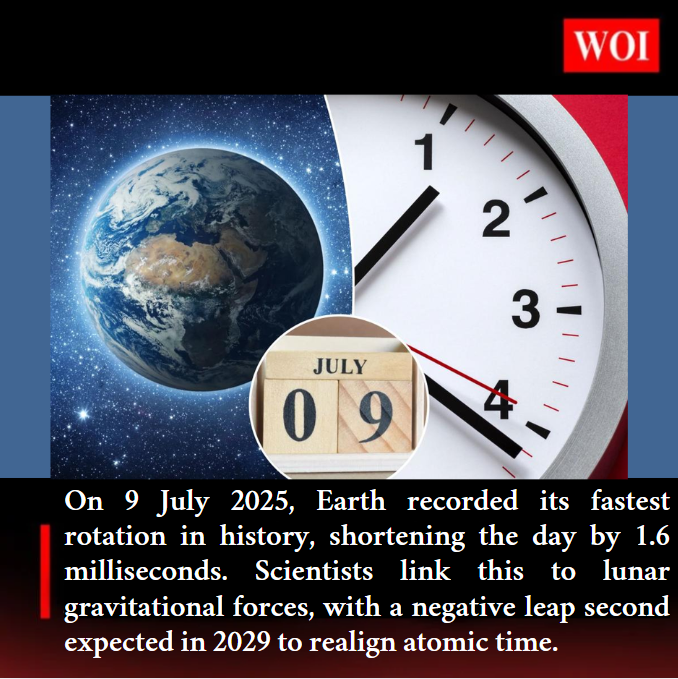
On 9 July 2025, Earth completed its fastest rotation ever recorded, making the day 1.6 milliseconds shorter than the standard 24 hours. This unexpected acceleration in Earth’s spin has important implications for global timekeeping and scientific research.
What Causes Earth’s Rotation to Change?
Earth’s rotation isn’t fixed—it varies due to a combination of factors like:
- Gravitational pull from the Moon
- Seismic activity
- Atmospheric pressure and ocean currents
The Moon’s tidal forces are a major player in slowing or slightly speeding up Earth’s spin. But on certain days, like 22 July and 5 August 2025, Earth is expected to spin faster, following a temporary acceleration trend.
Impact on Timekeeping: Leap Seconds
To keep Coordinated Universal Time (UTC) aligned with astronomical time (UT1)—which is based on Earth’s actual rotation—scientists adjust time using leap seconds. Since 1972, 27 positive leap seconds have been added to slow down atomic clocks and match Earth’s slower rotation.
However, with Earth now spinning faster, a negative leap second is scheduled for 2029. This would be the first time a second is subtracted from UTC to stay in sync with Earth’s natural time.
What Is a Negative Leap Second?
A negative leap second means removing one second from the official time to correct for Earth’s faster rotation. It ensures atomic clocks stay aligned with Earth’s actual spin. The International Earth Rotation and Reference Systems Service (IERS) oversees these adjustments.
Why It Matters
This phenomenon may not affect daily life, but it’s crucial for:
- Global navigation systems
- Communication networks
- Scientific accuracy in space missions and Earth observation
It also helps scientists refine models of Earth’s internal dynamics and how it interacts with celestial bodies like the Moon and Sun.
