
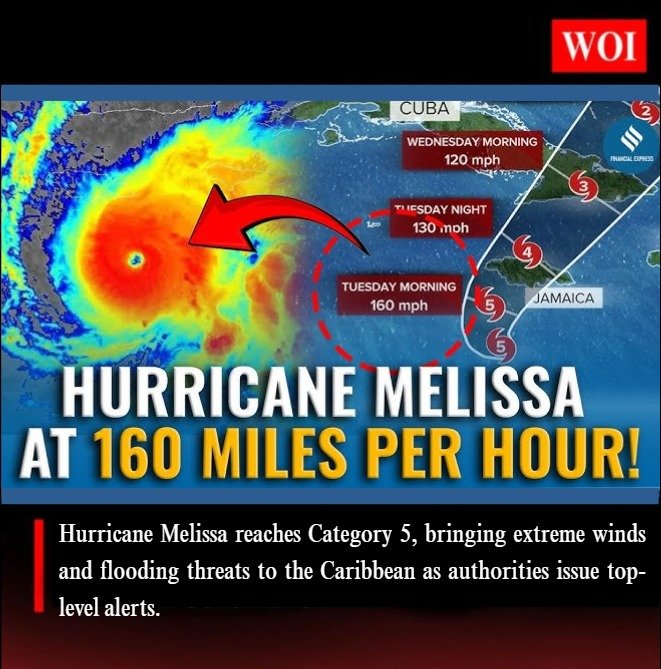
The Caribbean is bracing for catastrophic impact as Hurricane Melissa intensifies into a Category 5 storm — the highest level on the Saffir–Simpson scale. With sustained winds of 160 mph (257 km/h), the hurricane threatens widespread devastation across Jamaica and neighbouring islands. The U.S. National Hurricane Center (NHC) has issued urgent warnings for flash floods, storm surges, and prolonged power outages, marking one of the most powerful storms in recent memory.
How Hurricanes Form
Hurricanes develop over warm tropical waters (above 26.5°C) when rising moist air forms low-pressure systems that feed on oceanic heat. As wind speeds exceed 74 mph (120 km/h), the system is classified as a hurricane — a vast, spiralling powerhouse capable of stretching hundreds of kilometres.
Hurricane, Cyclone, or Typhoon?
Though identical in nature, these storms are named by region:
- Hurricanes – North Atlantic & Northeast Pacific
- Cyclones – South Pacific & Indian Ocean
- Typhoons – Northwest Pacific
Their rotation differs due to the Coriolis effect: anticlockwise in the Northern Hemisphere, clockwise in the Southern Hemisphere.
The Saffir–Simpson Scale
This international scale classifies hurricanes from Category 1 (minor damage) to Category 5 (total devastation):
- Cat 1 (74–95 mph) – Minor roof/tree damage
- Cat 2 (96–110 mph) – Major power line damage
- Cat 3 (111–129 mph) – Severe structural impact
- Cat 4 (130–156 mph) – Catastrophic building loss
- Cat 5 (157+ mph) – Uninhabitable destruction
With winds surpassing 157 mph, Hurricane Melissa ranks at the top, capable of flattening infrastructure and uprooting communities.
Exam-Oriented Facts
- Category 5 hurricanes have winds >157 mph (252 km/h)
- Form over waters warmer than 26.5°C (80°F)
- Scale: Category 1–5 (Saffir–Simpson)
- Hurricanes = Cyclones = Typhoons, differing only by region
The Call for a Category 6
Meteorologists are debating whether to introduce a Category 6 — as climate change fuels ever-stronger storms. Historical disasters like Katrina (2005) and Irma (2017) highlight that flooding and infrastructure collapse often cause more deaths than winds alone.
As Hurricane Melissa barrels through the Caribbean, it stands as a sobering symbol of climate extremes, urging nations to invest in coastal resilience, disaster preparedness, and climate adaptation.
