
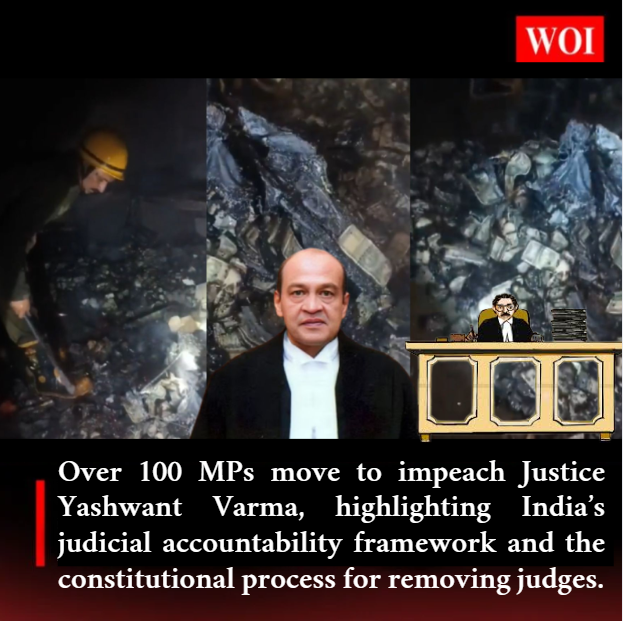
Allahabad, India — In a development that has sparked national conversation around judicial accountability, Justice Yashwant Varma of the Allahabad High Court is facing an impeachment motion. The motion comes after over 100 Members of Parliament (MPs) signed a notice seeking his removal — a move that meets the constitutional requirement to initiate the process in the Lok Sabha.
The notice was confirmed by Union Parliamentary Affairs Minister Kiren Rijiju, who announced that the motion has met the minimum support threshold and is officially under consideration.
What Led to the Motion
The impeachment proposal was initiated following an internal judicial inquiry led by a committee of three High Court judges. The committee found Justice Varma culpable in a matter involving the discovery of half-burnt currency notes at his official residence — a serious charge that raised red flags regarding potential misconduct.
The indictment has stirred public debate about the transparency and accountability of the judiciary, placing the spotlight on rarely used constitutional provisions designed to address such cases.
What Does the Constitution Say
The removal of a High Court or Supreme Court judge is a complex process, grounded in constitutional law and detailed legislative procedure:
Key Legal Provisions:
- Article 124(4) & (5) – Pertains to the removal of Supreme Court judges
- Article 217 – Applies to High Court judges, outlining their appointment and conditions for removal
- Judges (Inquiry) Act, 1968 – Establishes the framework for investigation and motion procedures
- Article 121 – Prohibits discussions in Parliament on a judge’s conduct except during the impeachment process
How the Impeachment Process Works
- Initiation: Requires a notice signed by 100 MPs from the Lok Sabha or 50 from the Rajya Sabha
- Investigation: A committee of three judges investigates the allegations
- Deliberation: If the judge is found guilty, a motion is tabled and debated
- Approval: The motion must pass both Houses of Parliament with a special majority
This is a rare and serious step, historically used sparingly, underscoring the gravity of the charges involved.
National Reactions
Legal experts and political commentators have expressed concern over the severity of the allegations. Some see this as a test of the judiciary’s willingness to hold itself accountable, while others caution against politicizing the judicial process.
“The judiciary must remain above suspicion, and the impeachment process — though rare — is crucial to uphold that trust,” said a senior legal analyst.
The Broader Impact
This case brings India’s judicial oversight mechanisms into the spotlight at a time when public demand for transparency in governance is growing. It also sets the stage for conversations about:
- Judicial integrity
- Institutional accountability
- The role of Parliament in checks and balances
As the motion progresses, it will be closely watched for its legal, political, and public ramifications.
Stay Tuned
Whether the motion will proceed to full debate and vote remains to be seen. What’s certain is that this development has revived public discourse on the power, independence, and responsibility of the Indian judiciary.
