
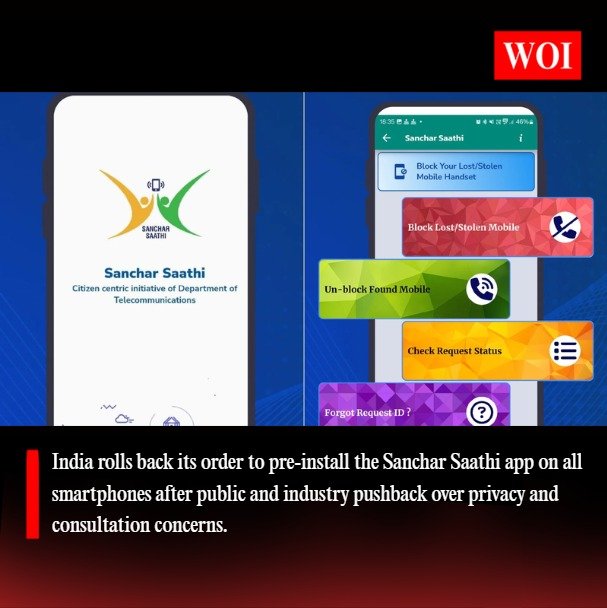
In a significant policy reversal, the Government of India has withdrawn its directive requiring all smartphone manufacturers to pre-install the Sanchar Saathi app on mobile devices sold or imported in the country. The rollback, announced on December 3, 2025, follows widespread concerns from users, privacy advocates, and industry bodies over potential snooping risks and the lack of prior consultation.
Sanchar Saathi, launched earlier in 2025 by the Department of Telecommunications (DoT), is designed to help users combat mobile theft, SIM-related fraud, and unauthorised connections. The app has shown strong adoption, with more than 1.5 crore downloads, tracing 26 lakh stolen phones, returning 7 lakh devices, and blocking over 6 lakh fraud attempts.
The original mandate—issued on November 28, 2025—required brands like Apple, Samsung, Xiaomi, Oppo, and Vivo to pre-install the app and even push it via updates to existing devices. This triggered pushback from privacy experts, who feared misuse; analysts, who questioned data protections; and industry associations, who criticised the lack of stakeholder dialogue.
Telecom Minister Jyotiraditya Scindia clarified in Parliament that the app does not enable snooping, functions only after voluntary user registration, and can be deleted anytime. The Ministry of Communications reaffirmed that growing voluntary adoption made mandatory installation unnecessary.
The India Cellular & Electronics Association (ICEA) welcomed the move as “balanced and pragmatic,” while digital rights advocates urged the government to revisit other restrictive measures like SIM-binding policies.
For consumers, the app remains optional, with no forced installation. For manufacturers, the reversal eases operational pressures and signals a shift toward consent-based digital security. The decision also highlights the government’s willingness to recalibrate policies in response to public concerns—setting a notable precedent for future digital governance.
