
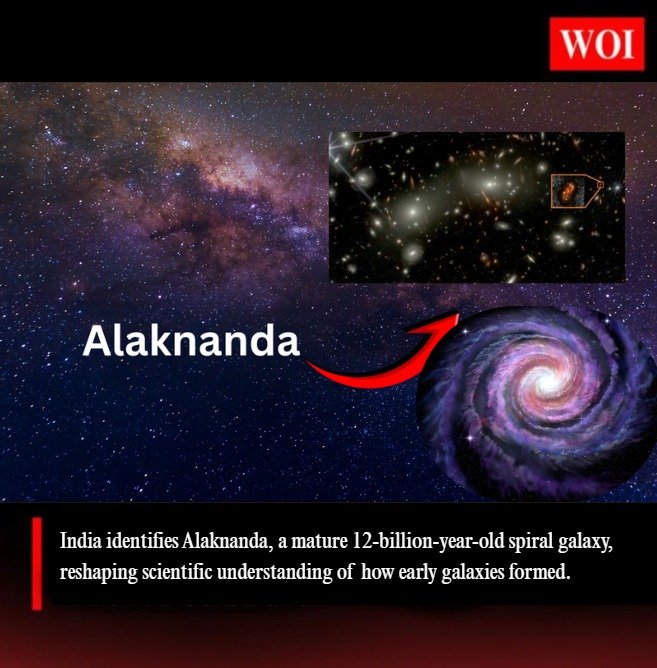
Indian astronomers have identified a remarkably mature ancient galaxy named Alaknanda, a discovery that challenges long-standing theories of early cosmic evolution. Detected using the James Webb Space Telescope (JWST), the galaxy dates back 12 billion years, to a time when the universe was just 1.5 billion years old.
A Fully Formed Spiral in the Early Universe
Unlike the small and irregular galaxies typical of that era, Alaknanda displays a grand design spiral structure, complete with a bright central bulge and two symmetrical arms. The system spans 30,000 light-years and contains nearly 10 billion stars, forming new stars at a rate 20–30 times faster than the Milky Way.
Indian Scientific Breakthrough
The discovery was led by researchers at the National Centre for Radio Astrophysics (NCRA), TIFR Pune, who identified classic spiral features such as “beads-on-a-string” star clusters. Their findings indicate that stable, large spiral galaxies formed far earlier than predicted by standard cosmological models.
Rethinking Galaxy Formation
Existing theories suggest spiral galaxies require billions of years to develop disc stability. Alaknanda’s early maturity implies that galaxy growth in the young universe happened much faster than previously believed, with its mass—ten billion solar masses—accumulating in only a few hundred million years.
Next Steps in Research
Further observations with JWST and ALMA are planned to better understand the galaxy’s composition, evolution and star formation processes, offering new insights into early cosmic history.
