
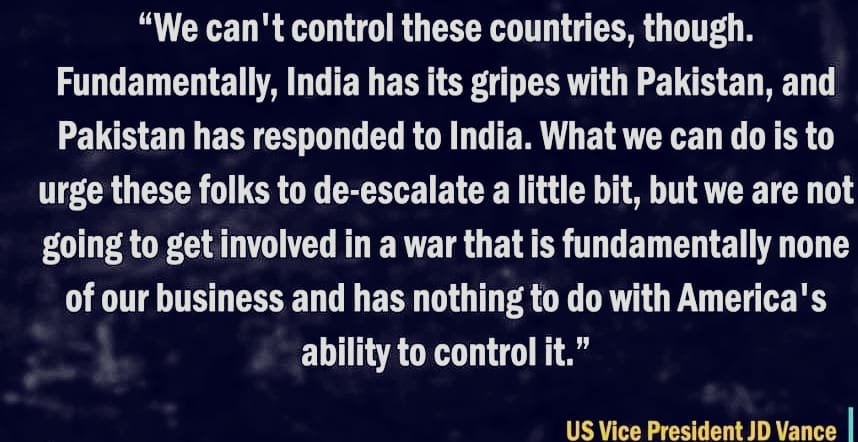
JD Vance’s ‘None of Our Business’ Remark: A New Chapter in U.S. Foreign Policy or Strategic Withdrawal?
U.S. Vice President JD Vance’s recent statement on the escalating India-Pakistan conflict—calling it “none of the U.S.’s business”—has sparked a flurry of reactions across diplomatic circles, global media, and policy think tanks. The blunt remark, made during an interview with Fox News, may be brief, but its implications are far-reaching.
For decades, the United States has played a delicate balancing role in South Asia, walking a tightrope between strategic partnerships with India and security cooperation with Pakistan. Vance’s words mark a stark shift from past U.S. administrations that at least paid lip service to mediating peace or offering back-channel diplomacy during times of crisis.
A Signal of Isolationism?
Critics view Vance’s stance as an echo of growing American isolationism—a sentiment that has gained traction since the Trump era and continues under certain wings of the Biden administration. In an increasingly multipolar world, where China and Russia are expanding their geopolitical footprint, America’s retreat from complex international disputes may leave a vacuum others are eager to fill.
India and Pakistan React
While India remains focused on securing its borders and maintaining regional stability, some Indian analysts perceive Vance’s statement as a green light to act without U.S. interference. Pakistan, on the other hand, may view the silence from Washington as a sign of waning support.
Former Indian ambassador Shivshankar Menon noted, “The U.S. may think this is not their business today, but if regional instability spills over or empowers extremist elements, it becomes everyone’s business tomorrow.”
Europe and the UN Urge Caution
European leaders and United Nations officials have urged both countries to show restraint. French President Emmanuel Macron emphasized “the importance of diplomacy over destruction,” while UN Secretary-General António Guterres called for “immediate de-escalation and dialogue.”
Strategic Ambiguity or Missed Leadership?
JD Vance’s remarks may reflect a calculated ambiguity meant to avoid entangling the U.S. in yet another foreign conflict. However, for many observers, it also signals a missed opportunity for the United States to exercise its soft power and global leadership in conflict resolution.
As missiles cross borders and fighter jets are downed, the world watches—and listens. JD Vance’s “none of our business” comment may resonate with American voters weary of foreign entanglements, but in the interconnected world of 2025, isolation rarely equates to immunity.
