
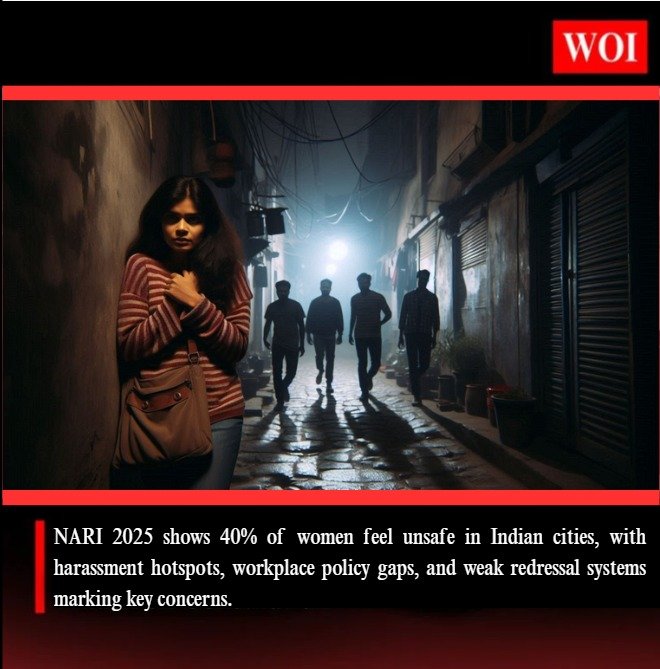
The National Annual Report and Index on Women’s Safety (NARI) 2025 offers a comprehensive look at urban women’s safety in India, surveying 12,770 women across 31 cities. The national safety score stands at 65%, yet 40% of women still feel unsafe in their cities.
City Rankings
Kohima, Visakhapatnam, and Bhubaneswar ranked highest for women’s safety due to better infrastructure and policing. On the other hand, Patna, Jaipur, and Delhi scored the lowest, reflecting weaker institutional support and cultural barriers.
Harassment Trends
- 7% of women reported harassment in 2024, rising to 14% among women under 24.
- Verbal harassment (58%) was the most common, followed by physical, psychological, economic, and sexual harassment.
- Hotspots included neighbourhoods (38%) and public transport (29%), with risks increasing after dark.
Workplace Safety
While 91% felt safe at work, over half (53%) were unaware of the POSH policy. Awareness remains as crucial as the law itself.
Trust in Authorities
Only 1 in 3 victims reported harassment formally, and just 16% of cases saw action. A striking 75% of women lack trust in police and legal systems, fueling underreporting.
A Broader View
The report stresses that women’s safety is more than law enforcement—it includes psychological, financial, and digital security. Holistic solutions involving urban planning, institutional reforms, and social change are key to ensuring women’s dignity and freedom.
