
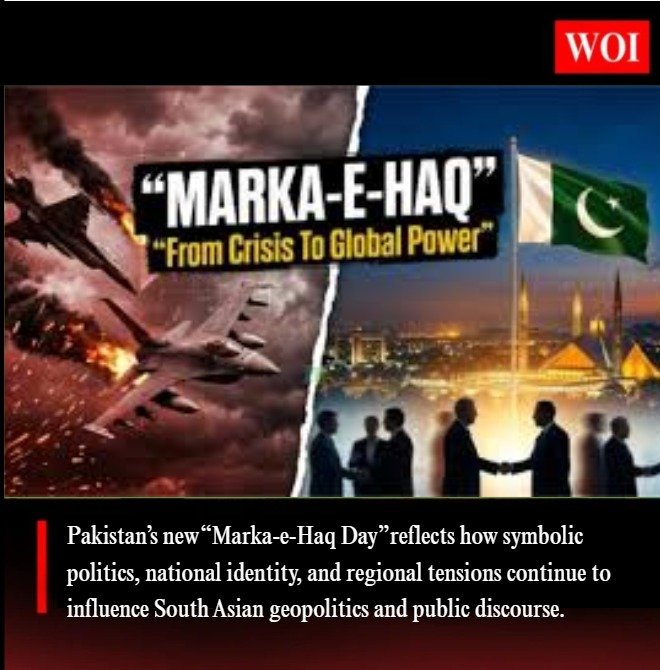
Pakistan Prime Minister Shehbaz Sharif recently announced that May 10 will now be observed annually as “Marka-e-Haq Day,” a move that has drawn attention across South Asia due to its political and symbolic significance. The phrase “Marka-e-Haq” roughly translates to “Battle for Truth” or “Battle for Justice” and is being presented as a symbol of national resilience, unity, and identity.
Political observers note that symbolic national observances are rarely limited to ceremonies alone. Such declarations often serve broader purposes including strengthening public sentiment, reinforcing national narratives, and shaping political discourse during periods of geopolitical tension.
The announcement comes at a time when relations between India and Pakistan continue to remain sensitive because of long-standing border disputes, security concerns, and competing political narratives. In such environments, symbolic gestures and commemorative events frequently become part of wider domestic and regional messaging strategies.
Experts believe governments often use symbolic national days to encourage patriotism, strengthen internal unity, and connect public opinion with larger national identity themes. In South Asia, where historical memory and political symbolism play major roles in public discourse, such announcements can carry diplomatic and strategic implications beyond their official meaning.
The declaration of Marka-e-Haq Day also highlights how political identity and regional tensions remain closely interconnected in the subcontinent. Analysts say the growing use of symbolic politics reflects how governments increasingly rely on historical narratives and emotional messaging to shape national consciousness and public engagement.
While the observance itself is largely symbolic, its timing and presentation underline the continuing importance of political narratives in shaping regional relations and public opinion in South Asia.
